If you spend most of your day at a desk, you have probably noticed it. The dull ache between your shoulder blades by midafternoon. The tightness across your low back when you stand up. The neck that feels stiff every time you turn to check the time.
You have also probably noticed something else. You try things. A massage. A walking break. Standing up more often. A new chair. The pain goes away for a while, and then it comes back. Usually faster than you expected.
There is a reason it keeps coming back. And it is not the chair.
Your spine is built to move. Sitting asks it not to.
When you sit for eight hours, two joint complexes carry most of the cost: your shoulders, and your hips. Both are designed for movement through wide ranges in multiple planes. When you hold them still, they do not just rest. They begin to lock.
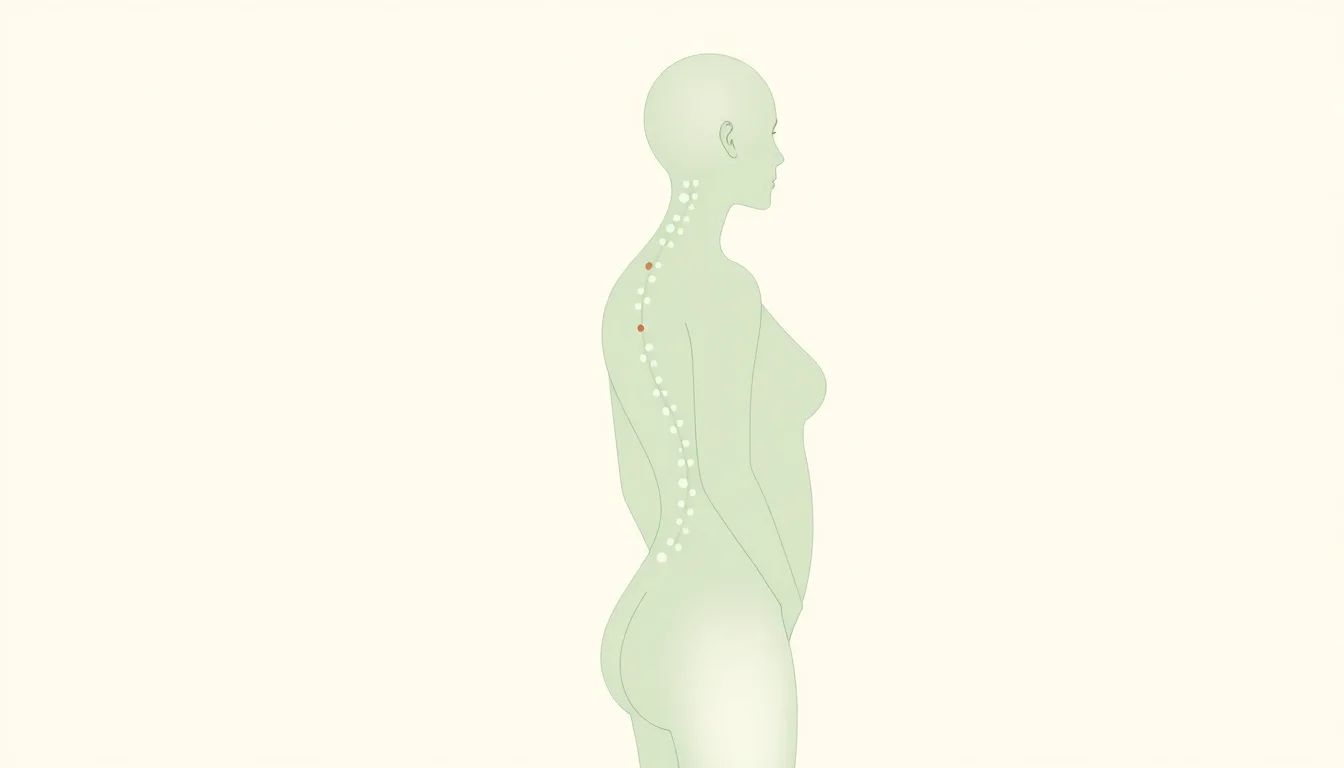
The shoulders round forward as the chest collapses. The hip flexors at the front of the pelvis shorten. The thoracic spine, the upper-mid back, loses its natural extension, and the head drifts forward to compensate.
Dr. Jacqueline Yun, a biomechanical engineer who teaches therapeutic yoga, calls the shoulders and hips the body's two central joints. They sit at the structural crossroads of every movement you make: every reach, every step, every twist. When they stiffen, the joints around them are forced to compensate. The lumbar spine bends in place of the hips. The neck juts forward in place of the upper chest opening. Over time, those compensating joints take loads they were not designed for. The ache between your shoulder blades is one of the first places that shows up.
This is why posture advice rarely sticks. Sit up straight is a position. It is not a structure. If your shoulders and hips are locked, sitting up straight asks your body to hold a shape it cannot sustain, and within minutes you collapse back into the rounded one.
Why the pain keeps coming back
So you book a massage. You feel better for two days. Sometimes three. Then the same tightness returns, often in the same exact place.
Massage relieves a symptom. It does not fix a cause. The muscles that were tight relax for a while, but the joint they were guarding is still locked, and the muscle around it has no choice but to tighten again to protect what is not moving.
The same pattern shows up with stretching alone, and with new chairs alone. Stretching opens muscle for a few minutes, but the joint underneath needs more than a stretch to change its baseline range. A new chair changes the surface you are sitting on, but the joints in your body do not get a vote.
This is the part most people miss. Pain that returns is not a failure of effort. It is a sign the intervention is happening at the wrong layer.
The problem is rarely that you lack force. The force is there. It is that the force is being used in the wrong place.
To make the relief stick, the work has to happen in three places at once.
The three-element framework
Dr. Yun's clinical approach builds on a framework she has refined over twenty years of teaching: joint mobility, postural correction, and muscle strength. All three. Not one of them, and not two of them. All three, in that order.
Joint mobility comes first. This is the opening her Mandarin students recognise as 关节舒缓. Before the body can hold a corrected posture or build strength in the right place, the joints have to have somewhere to move. Locked shoulders and hips cannot be strengthened into alignment. They have to be released first, and gently. Forcing range into a stiff joint is the fastest way to injure it.
Postural correction comes second. Once the joints can move, the spine can find its natural shape again: the soft curves at the neck and low back, the long line through the thoracic spine, the pelvis sitting level on top of the hips. This is not a position you hold. It is a structure you keep finding, again and again, until it becomes the resting state.
Muscle strength comes third. This is where the relief becomes permanent. Once the joints have range and the spine has alignment, the supporting muscles, especially the deep stabilisers around the spine and pelvis, need to be strong enough to hold that alignment under load. Without this step, the corrected posture collapses the moment you stand up. With it, your body has a structural baseline to return to all day.
People who do only the first two get a temporary fix. People who jump straight to the third, trying to strengthen their way out of pain without addressing mobility or alignment first, often make the pain worse. They build force into a body that is still misaligned.
The sequence matters as much as the work.
Four poses, six minutes, twice a day
Here is what this looks like in practice. Not a workout. A reset.
- Doorway chest opener (60 seconds per side). Stand in a doorway, place your forearm on the frame at shoulder height, step forward through the opening. The point is not to feel a stretch. It is to feel the chest expand. If you do not feel anything, take a smaller step and hold longer.
- Low lunge with arms overhead (60 seconds per side). One knee on the ground, the other foot forward. Press the hips gently forward, lift the arms. This opens the hip flexor at the front of the back leg, the one that shortens most in sitting. Keep the low back long, not arched.
- Sphinx with thoracic lift (90 seconds). Lie on your stomach, forearms on the floor under the shoulders. Press the forearms down and lift the upper chest, but keep the low back relaxed. The work is in the upper-mid back, not the lumbar spine. This is the position the desk takes away.
- Single-leg balance at the desk (60 seconds per side). Stand on one foot, lift the other knee to hip height, hold. Hands on a chair back if needed. This trains the deep hip stabilisers that hold the pelvis level when you walk and sit. It also tells your nervous system that you have stable ground, which lowers shoulder tension by an amount most people do not expect.
Six minutes. Once before you start work, once before you stop. The same four poses, two passes.
What changes when you do this
The shift is not dramatic at first. The first week, you will probably notice the four o'clock pain fading earlier in the afternoon. The second week, the neck stiffness when you turn to check something will be less reliable. By the fourth or fifth week, most people stop noticing their back at all when they sit. Not because the back disappeared. Because the body found a structural baseline it can hold without complaint.
This is the difference between treatment and practice. Treatment relieves a symptom and ends. Practice changes the resting state of the body, and that state stays.
If you have been trying to fix this for years without much to show for it, that is the gap. The good news is that the gap is closeable, in less time than most desk workers expect, and with practice that fits inside the day rather than competing with it.
Desk-driven pain responds to consistency more than intensity, which is why the first month matters more than the first class. Start your first month for SGD 196.