Yes, and the evidence behind that answer has grown considerably in recent years. The more precise question is not whether yoga is good for older bodies, but which kind of yoga, approached which way. Gentle, well-modified practice that meets you where your body actually is today: that is what the research supports, and that is what makes sense for anyone starting after 60.
This article covers what yoga genuinely does for the body as it ages, addresses the concerns most newcomers carry, and explains why practising from home online removes most of the barriers that stop older beginners from ever trying.
What the research actually shows
A 2023 review of 33 controlled studies, covering 2,384 adults over 65, found that yoga meaningfully improved two markers that doctors use as predictors of healthy ageing: walking speed and the ability to rise from a chair without using your arms. Both are associated with greater independence and lower frailty risk. The review was led by researchers at Brigham and Women's Hospital, a Harvard Medical School affiliate, and published in Annals of Internal Medicine.
A separate meta-analysis published in Age and Ageing looked specifically at balance and physical mobility in adults aged 60 and over, and found consistent improvements across multiple studies.
These are measured findings from controlled trials, not marketing claims. They describe what happens when older adults practise gentle yoga regularly over several weeks.
What yoga does for an ageing body
Stiffness and range of movement
The morning stiffness that worsens through your 60s and 70s is largely a joint-mobility problem. Joints that move through their full range regularly stay better lubricated and more comfortable. Yoga poses work systematically through the hips, spine, shoulders, and ankles, the areas where older adults typically lose range first.
In a pilot study published in the Journal of the American Geriatrics Society, older adults with knee osteoarthritis who practised chair yoga for eight weeks reported reduced pain and fatigue, with improved walking ability. Their gains were still measurable at three-month follow-up.
Stiffness responds to consistent, gentle movement. Yoga is unusually well-suited to delivering that.
Strength you actually use
Standing up from a low chair. Carrying groceries. Steadying yourself on uneven ground. These depend on leg strength and core stability, both of which decline without regular use.
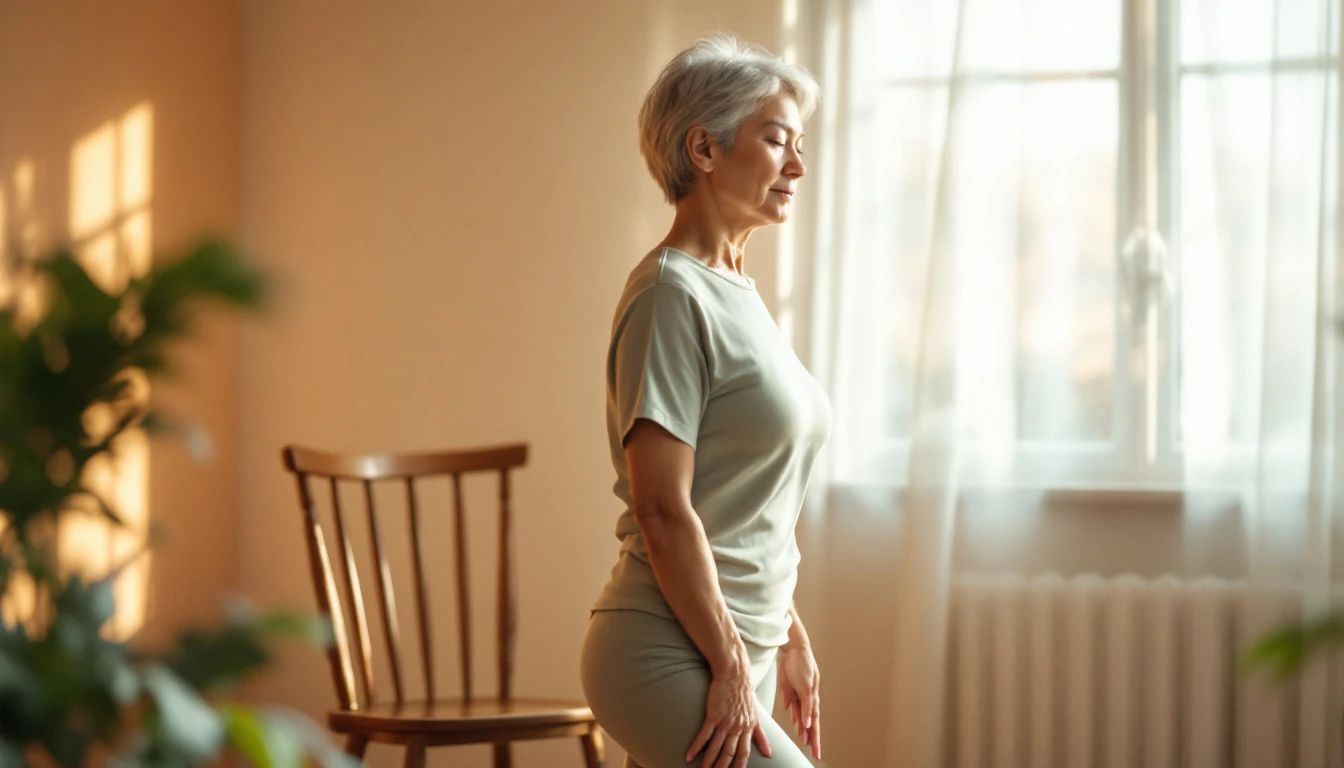
Yoga builds these in ways that feel nothing like a gym workout. Holding a chair-supported standing pose asks your legs to work. Moving slowly between positions trains your core without impact. Studies of chair yoga programmes for older adults consistently show improvements in lower-limb endurance and the ability to perform daily tasks more easily.
Balance and confidence
Balance is the combined result of hip and ankle strength, proprioception (your body's sense of its own position in space), and the nervous system's ability to make quick corrections. Yoga trains all three at once.
A 12-week Iyengar yoga programme, studied in adults aged 59 to 87, significantly improved balance and mobility. The 2023 review confirmed that balance confidence improves with yoga practice.
One point of honesty worth including: a 2025 randomised controlled trial published in The Lancet Healthy Longevity found that a specific Iyengar yoga programme did not reduce the overall fall rate in participants over 60. Improved confidence may even have led participants to attempt more demanding activities than before. What this means for a beginner is not discouraging. Yoga builds physical capacity and the confidence to move more, and it works best alongside a clear awareness of your own limits. A good teacher helps you develop both.
Breathing, sleep, and mood
Yoga pays unusual attention to the breath. Slow, deliberate breathing activates the parasympathetic nervous system, the branch responsible for calm and recovery. For older adults carrying chronic stress or sleep difficulty, the breathwork component is often what they notice first.
A meta-analysis in Complementary Therapies in Clinical Practice found that yoga improved sleep quality in older adults across multiple studies. A 2024 study published in the Journal of Applied Gerontology found reduced anxiety and depression, and improved mood, in older adults after an eight-week yoga programme.
These are not side effects. They are why many people over 60 who start yoga describe it as the most sustained positive change they have made in years.
Your questions, answered plainly
I am not flexible enough to do yoga
Flexibility is not a prerequisite. A chair nearby, a wall for balance, a folded blanket under a knee: these are standard tools in a gentle class, not signs that something is wrong. Most poses can be done with far less range of movement than the photographs suggest.
I might hurt myself
The answer depends on the style of class and whether the teacher modifies for the people actually in the room. Vigorous flow classes are not appropriate for most people starting after 60. Gentle yoga, restorative yoga, and chair-supported practice are specifically structured for older bodies. Every research trial that found benefits was using gentle or moderate programmes.
If you have had a recent surgery, a joint replacement, significant osteoporosis, or a condition affecting your balance, speak with your doctor first. That conversation usually takes five minutes and often ends with a green light.
What if I cannot get down to the floor?
Many people over 60 practise yoga entirely with a chair for support, or seated throughout. Floor work can be introduced gradually, or not at all. Full benefit is available without it.
Why practising at home changes things
Walking into a studio where everyone else seems younger and more flexible stops more people than physical limitation does. Practising from your living room removes that entirely.
There is no commute, and no comparing yourself to the person beside you. There is a screen, your own space, and a teacher who can see you and guide you. Research on online yoga delivery has confirmed it is feasible and safe for older adults, including those managing chronic conditions.
For someone new to practice and uncertain how their body will respond, the privacy of home is genuinely useful, not a compromise.
A place to begin
A single session a week is enough to start. What matters more than frequency, at the beginning, is that the class is paced gently and that modifications are offered as a matter of course.
At Inner Heal Transformation, the online group classes run 60 to 75 minutes, structured around themes including joint mobility, breathwork, and restorative practice. You go at your own pace. If a pose does not work for your body that day, there is always a supported alternative.
The first-month trial gives you 30 days of unlimited access for SGD 196, time enough to feel the difference in how you move in the mornings after a class, and to decide what you want next.
The researchers at Brigham and Women's Hospital said it plainly: it is never too late to start a yoga practice. What they found, across thousands of participants over 65, is that older bodies respond. Gradually, with consistency, in ways that compound quietly. That is what gentle yoga at this stage of life is for.