Dr. Jacqueline Yun's timing for Nauli after birth is 3 months after a vaginal delivery and 4 to 6 months after a caesarean section, and only once you are fully recovered and any diastasis recti has healed. If you are pregnant, Nauli waits until after the birth, and there is plenty you can do in the meantime.
You may have seen Nauli as a short clip of a belly rolling from side to side and wondered when you could learn it. Pregnant women have been asking Dr. Yun of Inner Heal Transformation exactly that. This page gives her answer and the reasoning behind it, then shows how to prepare. What Nauli trains, and how it is learned in stages, is covered in what nauli kriya trains and how it is learned safely.
In short
- Dr. Yun's timing after a vaginal delivery is 3 months, with full recovery.
- After a caesarean it is 4 to 6 months. If there is still pain, wait until you are fully recovered, even if that is past 6 months.
- Diastasis recti needs to heal before you start, whatever the date on the calendar.
- Nauli trains control of the abdominal wall, and no research reviewed here shows that it reduces belly fat.
- Gentle, breath-led movement can begin much earlier, and the postpartum guides linked below show how.
When can I start core exercises after giving birth?
Gentle, breath-led work can usually begin within days of an uncomplicated vaginal birth, once you feel ready. Harder abdominal work waits for your postnatal clearance, and the NHS places the postnatal check at 6 to 8 weeks after the birth. After a caesarean or any complication, ask your doctor first.
ACOG says it is usually safe to begin exercising a few days after giving birth, or as soon as you feel ready, and to ask your ob-gyn when to start after a caesarean birth or complications. The NHS notes that after a caesarean, exercise may not be comfortable for 6 weeks or so, and suggests asking your midwife or your GP at the 6-week check. Inner Heal's guide to how long after giving birth you can start yoga again sets out the same order. The postnatal check clears you to begin, and recovery carries on well beyond it.
Those are the dates for ordinary exercise. Nauli follows a longer timeline.
When can I start Nauli after pregnancy?
The timing comes from Dr. Yun's own list of who should avoid Nauli. Pregnant women are on it, and so are postpartum women less than 3 months after delivery or not yet fully recovered. The full list also covers menstruation, cardiovascular conditions such as high blood pressure, and gastrointestinal or internal organ issues, and the Nauli guide sets it out in full. For the postpartum months she gives these dates, and the table puts each next to what you can do meanwhile.
| Situation | When Nauli can start, per Dr. Yun | Meanwhile |
|---|---|---|
| Pregnant | After the birth. Pregnant women are on her list of who should avoid Nauli. | Ask your doctor or midwife which movement suits your pregnancy, and read ahead. |
| Vaginal delivery | 3 months after the delivery, once you are fully recovered. | Breath-led movement, as in the [first 12 weeks postpartum guide](/insights/first-12-weeks-postpartum-yoga/). |
| Caesarean section | 4 to 6 months after. If there is still pain, wait until you are fully recovered, even past 6 months. | Let the incision settle, and ask your doctor about it before any abdominal work. |
| Diastasis recti still present | It needs to heal before you start. | The coning check in the [diastasis recti guide](/insights/diastasis-recti-yoga-safe/), once your doctor has cleared you. |
Dr. Yun's dates come with recovery attached, so reaching the date does not by itself mean you are ready. If you are unsure where you stand, ask your doctor first.
Why does Nauli wait when other movement can start sooner?
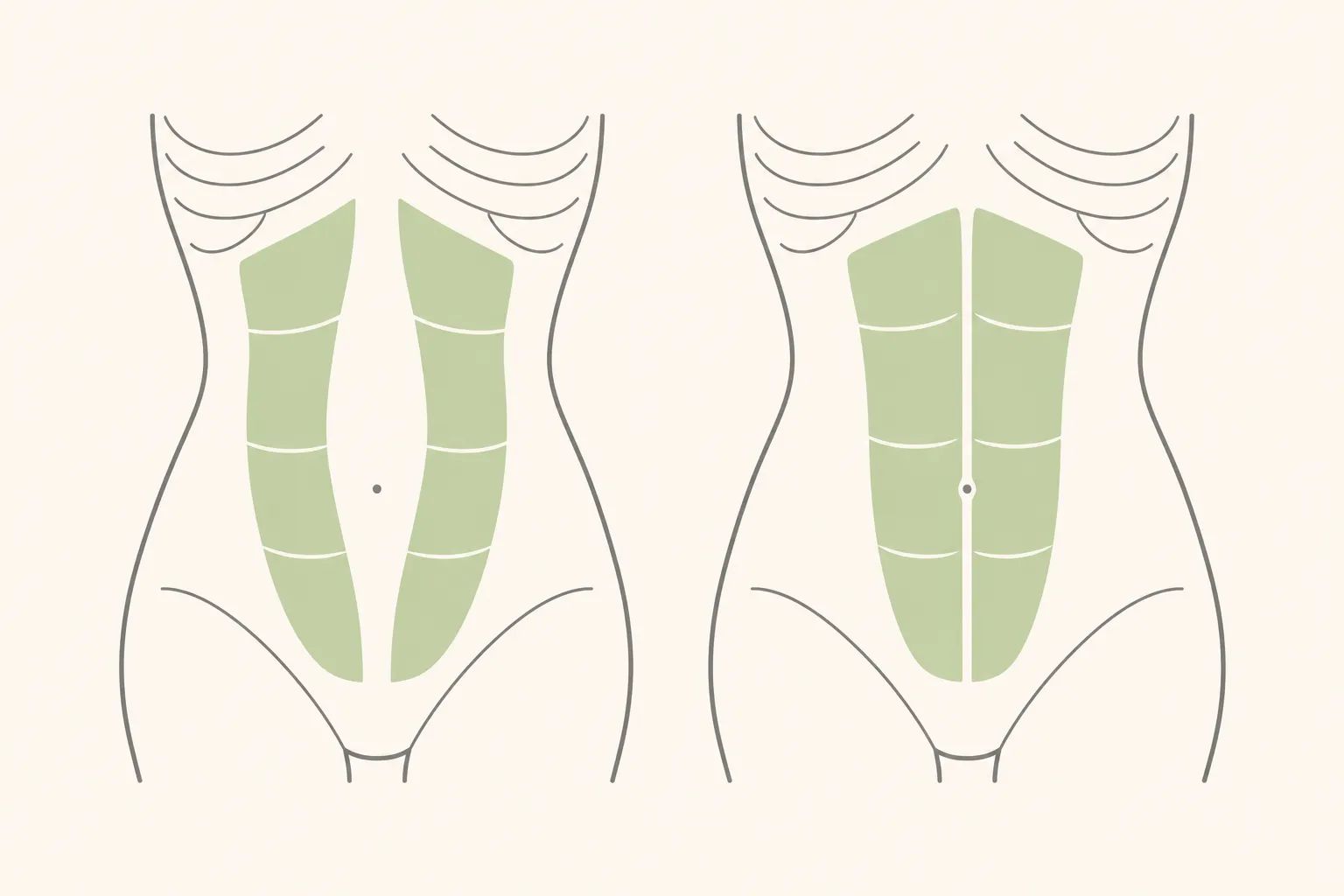
Nauli is done on a held breath, with the abdomen drawn up under the ribs and the central rectus abdominis muscle switched on by itself. That makes a deliberate demand of the abdominal wall at the time it is still rebuilding, and as the diastasis recti guide explains, the deep abdominal wall and the pelvic floor work together.
In a Norwegian study of 300 first-time mothers, diastasis recti, a palpated gap of two fingerbreadths or more, was found in 60.0% at 6 weeks and still in 45.4% at 6 months. A gap that is still there at 6 months is common, and Dr. Yun's rule is that it heals before Nauli begins.
How hard the abdominal muscles work matters to that midline. In a 2016 ultrasound study, a curl-up narrowed the gap in 26 women with diastasis recti but distorted the linea alba, the band of tissue between the two halves of the rectus. The 17 women without diastasis showed no change. A curl-up is not Nauli, and none of the research reviewed for this article tested Nauli after birth. What it shows is that the midline responds to how the abdominal wall is loaded, and a practice that isolates the rectus on a held breath is a reason to follow the longer timeline.
The timeline has a hopeful half. In a Swedish cohort of 504 women, diastasis recti and vaginal heaviness decreased and pelvic floor strength increased between 3 and 12 months after birth. Pelvic girdle pain eased in women doing low-impact exercise and stayed the same in women doing none or high-impact exercise, although an observational study shows only an association. Recovery that takes longer than 6 months is common, and these measures kept improving through the first year.
What can I do while I wait?
Begin with the order Inner Heal's postpartum guides already set out. The first 12 weeks postpartum guide walks through what each stage is for. Once your doctor has cleared you, the coning check in the diastasis recti guide takes about a minute, and a ridge pushing up along the midline tells you to reduce the load.
Postpartum poses to avoid explains the five poses that commonly cause coning after birth, each with a version that keeps the benefit.
Leaking or pain is a question for your doctor or a pelvic-health physiotherapist before any new practice. If you are pregnant, ask your midwife or doctor which movement suits you now. Nauli can wait for the months after the birth.
How can I learn Nauli with Dr. Yun when the time is right?
Dr. Jacqueline Yun holds a PhD in Mechanical Engineering from NTU and is an E-RYT 200 teacher. At Inner Heal she runs a guided workshop called Nauli 陪跑营, where 陪跑 means she trains alongside you. It costs S$58 and runs online, with a 1-to-1 format available. The next intake is in mid-January, with dates to be announced.
If your timing is right, you are welcome to register your interest. If you would like someone to look at your own pattern first, a 1-on-1 session starts with a Movement and Posture Assessment, and the classes page has the details.
This is general information and not medical advice. Ask your doctor before you start, and again if anything changes.
Frequently asked questions
Can I do Nauli while pregnant?
No. Pregnant women are on Dr. Yun's list of who should avoid Nauli, so Nauli during pregnancy waits until after the birth. Ask your midwife or doctor which movement suits you now.
Does Nauli flatten a postpartum belly?
Nauli trains control of the abdominal wall, and the research reviewed for this article does not show that it reduces belly fat. In a 2011 trial of 24 healthy, sedentary adults, 6 weeks of abdominal exercise, 5 days a week, did not significantly change abdominal fat or abdominal circumference, although curl-up endurance improved. This article makes no promise about body shape. If you want to feel strong through your middle again, the gentle return in the guides above is where that begins.
What if I still have diastasis recti at 6 months?
Dr. Yun's rule is that it needs to heal before you start Nauli, so you wait. You are in large company, since 45.4% of the Norwegian cohort still had a gap at 6 months, and by 12 months the share had fallen to 32.6%. Whether yours has healed is a question for someone who can examine you, such as your doctor or a pelvic-health physiotherapist. Meanwhile the gentle work carries on.
Should I see my doctor before starting Nauli?
Yes. Ask at your 6 to 8 week postnatal check and again before you begin, particularly if you have pain or leaking. Dr. Yun's list also names cardiovascular conditions and gastrointestinal or internal organ issues, and your doctor can advise on those too.
Sources
- NHS, Your 6-week postnatal check, page last reviewed 9 October 2026.
- NHS, Caesarean section: recovery, page last reviewed 4 January 2023, with its scheduled review date of 4 January 2026 passed.
- ACOG, Exercise After Pregnancy, FAQ131, last reviewed October 2024.
- Sperstad JB et al. Diastasis recti abdominis during pregnancy and 12 months after childbirth: prevalence, risk factors and report of lumbopelvic pain. British Journal of Sports Medicine, 2016. PMID 27324871.
- Lee D, Hodges PW. Behavior of the linea alba during a curl-up task in diastasis rectus abdominis: an observational study. Journal of Orthopaedic and Sports Physical Therapy, 2016. PMID 27363572.
- Vesting S et al. The impact of exercising on pelvic symptom severity, pelvic floor muscle strength, and diastasis recti abdominis after pregnancy. Physical Therapy, 2024. PMID 38109793.
- Vispute SS et al. The effect of abdominal exercise on abdominal fat. Journal of Strength and Conditioning Research, 2011. PMID 21804427.