A common worry from people who have never tried online yoga is straightforward. The teacher is on a screen, so the teacher cannot really see what my body is doing, so the practice cannot be corrected, so it cannot be safe. That logic feels solid until you sit with it for a moment. Then it starts to come apart.
The honest answer is that online yoga works very well for some things, has limits for others, and the gap between online and in-person is much smaller than most people assume. It is also much larger in places people do not expect. This article is about where each setup wins, where each one breaks, and how to decide which one fits your body right now.
What a camera actually shows
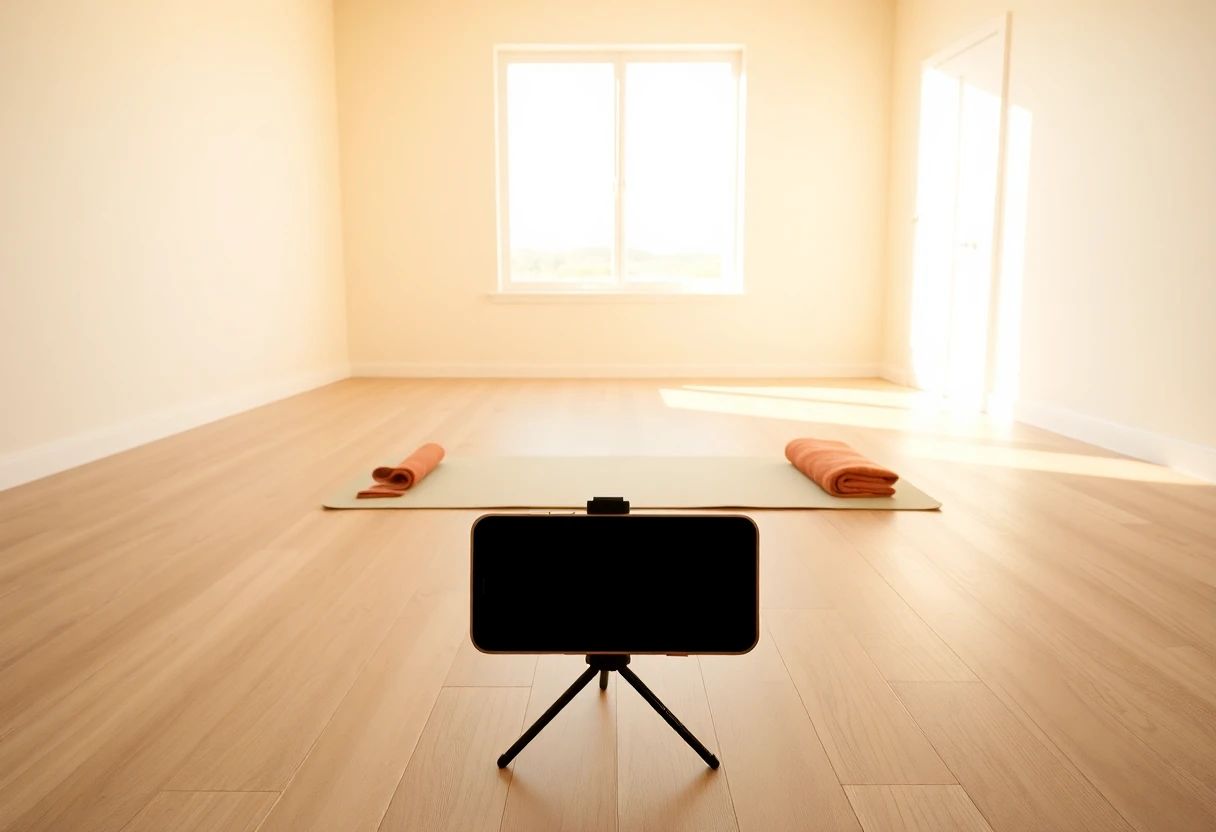
A good online setup is not a phone propped on a stack of books in poor light. It is a fixed wide-angle camera placed deliberately so the teacher can see your whole body from the side, the front, or both depending on the pose. The framing is checked before class begins. The teacher can see your spine, your hips, your knees, your shoulders, your breath, and the angle of every joint involved in the pose.
What a trained eye catches at that framing is, honestly, most of what matters. Whether you are folding from the hip or compressing the lower back. Whether your shoulders are creeping up toward your ears in a downward dog. Whether your knees are tracking over the toes or collapsing inward in a lunge. Whether your breath has stopped because the pose got too hard. Whether you are using arm strength to push through a movement that should be carried by the core.
These are not subtle things hidden behind a wall of muscle. They are gross movement patterns visible from across a room, and the same gross patterns are what the teacher would be looking at in person. A camera does not change them.
Where the camera genuinely misses
There are real limits, and pretending otherwise would be silly.
A camera cannot put hands on your body. So in poses where a small tactile cue would do the work of a hundred verbal cues (a hand on the lower back to remind the lumbar to lengthen, a finger placed under the chin to bring the head back over the spine), the teacher has to find another way in. Usually that means slower verbal breakdown, more demo, more time spent on what the sensation should be, before asking you to find it.
A camera also struggles with very subtle rotation. If a hip is internally rotated by a few degrees in a way that matters for your specific case, a sharp eye can still spot it on screen, but the cue to correct it has to land verbally rather than physically. Some students find their way to that correction on the first try. Others need three sessions to feel what the teacher is asking for.
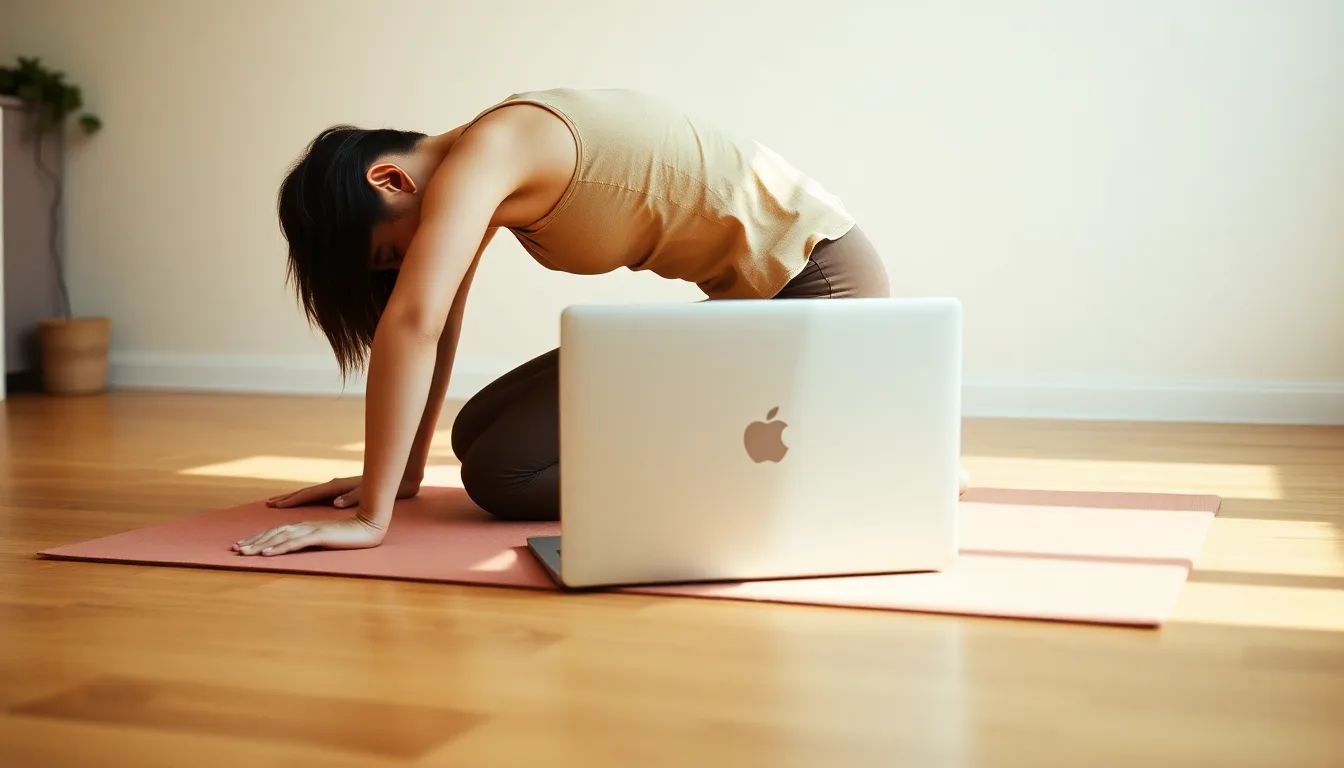
When in-person is genuinely needed
For most people most of the time, online is fine. There are real cases where in-person is the right call.
Acute pain. If you are in active pain right now, in a way that limits how you can position yourself in front of a camera, an in-person assessment first is the safer route. A teacher in the room can guide your body into a safe starting position with their hands. A teacher on a screen has to rely on you to do it.
Post-surgical recovery in the early weeks. Six weeks out from a spinal fusion or a meniscus repair is not the time to start figuring out alignment over Zoom. Once you are cleared for general movement and have a baseline, online works fine. Before that, in-person.
Severe balance issues. If a fall during a standing pose is a serious risk, having a teacher in the room who can actually catch you is worth more than any camera framing.
A body shape the camera angles cannot capture. Very tall, very short, very large, or very small bodies sometimes need the teacher to physically move around the body to see what is going on. Most studios can solve this with a second camera, but if your home space cannot, in-person resolves it instantly.
Notice what is not on this list. General stiffness, chronic posture issues, scoliosis maintenance, postpartum recovery past the first six weeks, desk-bound shoulders, anxious breathing, sleep that has gone sideways. All of these are well served by online practice with the right teacher.
The case for distributed practice
Here is the part that often surprises people. For most students, online is not a downgrade from in-person, it is an upgrade.
In-person classes are limited by where you live and how easy it is to get to a studio. They depend on you finding the energy to leave the house, get changed, sit in traffic, find parking, and arrive on time. They depend on the studio's schedule lining up with your week. When any of these break (and over a year of practice, all of them break repeatedly), the practice stops.
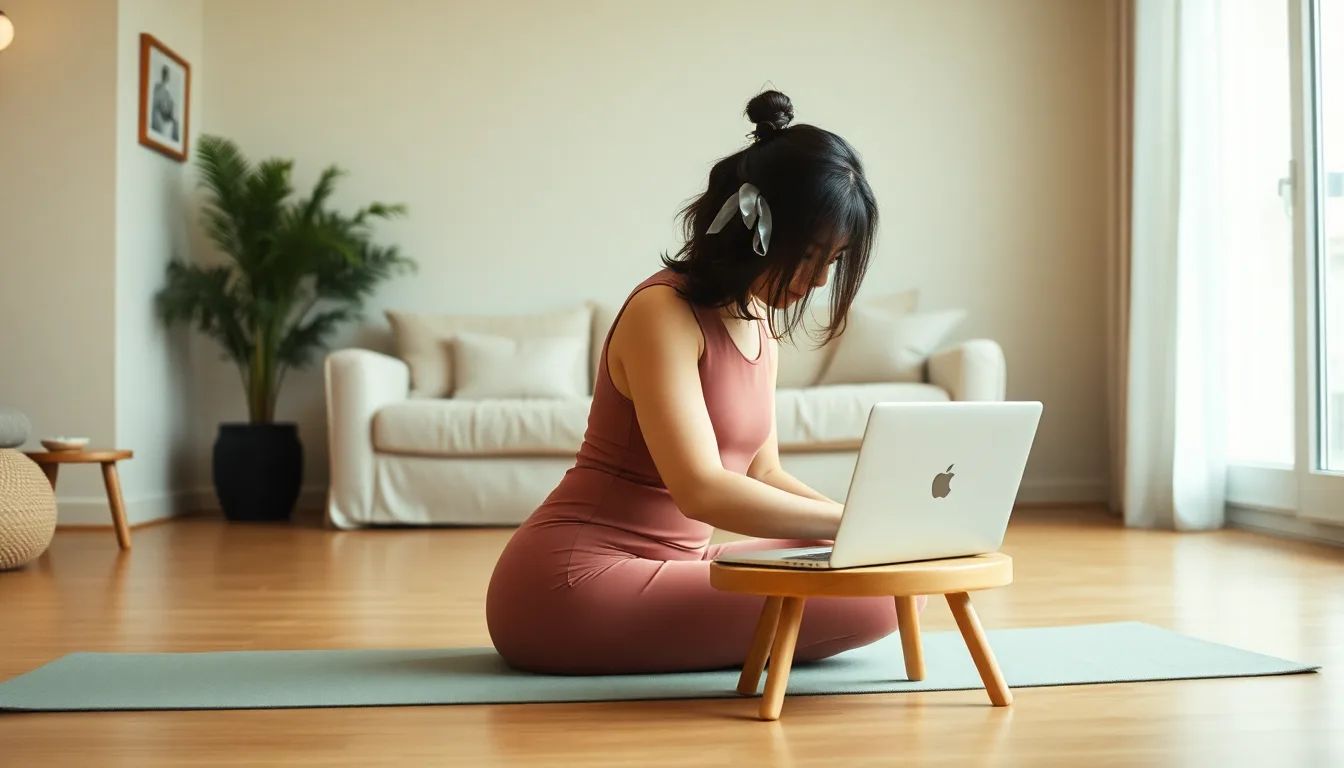
Online practice removes every one of those failure points. The studio is your living room. The commute is zero. The schedule is flexible. The cost is lower. And the camera, properly used, gives the teacher a reliable view of what your body is doing. Over a year, students who practice online consistently usually log significantly more total hours of movement than students who only practice in person, because the friction is gone.
For chronic conditions especially, this matters. Scoliosis, postural pain, postpartum core, mobility loss, none of these respond to a once-a-month intensive. They respond to small, consistent inputs over weeks and months. Geography that interferes with consistency hurts the outcome more than a camera ever could.
How to decide for your own body
The simplest framing is this. If you are in acute pain, post-surgical, or have a balance issue serious enough to risk a fall, start in person. Get a baseline. Get cleared. Then move to online for the long maintenance work.
If you are dealing with something chronic that has been there for months or years, and the gym felt wrong, and the studio felt overwhelming, online practice with a teacher who actually watches you is probably the missing piece. The fear that the teacher will not see what is happening is, in practice, not borne out. The slow consistency the format allows is.
If you have a strong preference for being in the same room as the teacher and the logistics work, that is a perfectly good reason to choose in-person. Preference is a real signal. Just do not let the assumption that online cannot work decide for you before you have tried it.
Inner Heal Transformation runs both formats. Online group classes and one-on-one over Zoom are the heart of the practice. In-person one-on-one in Singapore is available when the body genuinely needs it. The format is the second decision. The first is whether the teacher actually pays attention to what your body needs. With that part right, the rest follows.