You decide this is the year you will start yoga. You unroll the mat in the living room. You queue up a YouTube video. You do it twice, then life happens, and the mat ends up under the bed.
This is the most common home yoga story. It is not a failure of willpower. The setup was wrong from the start. What actually works for beginners learning yoga at home is the opposite of what most beginners try first.
Decide what you are actually doing
There are three different things people mean by "home yoga," and they are not interchangeable.
The first is following a video routine, which is closer to a guided workout. The second is building a personal practice, which means slowly learning the poses well enough to do them without a screen. The third is virtual classes with a real teacher, which is what most students settle into once they know the difference.
Decide which one you actually want before you start. Most people fail because they reach for option one expecting option two to happen by itself.
What you need (less than you think)
A yoga mat costs about thirty dollars. That is it. You do not need yoga blocks at the start. You do not need a yoga wheel. You do not need fancy clothes. The studios that sell you the props and the clothes are selling you the studios.
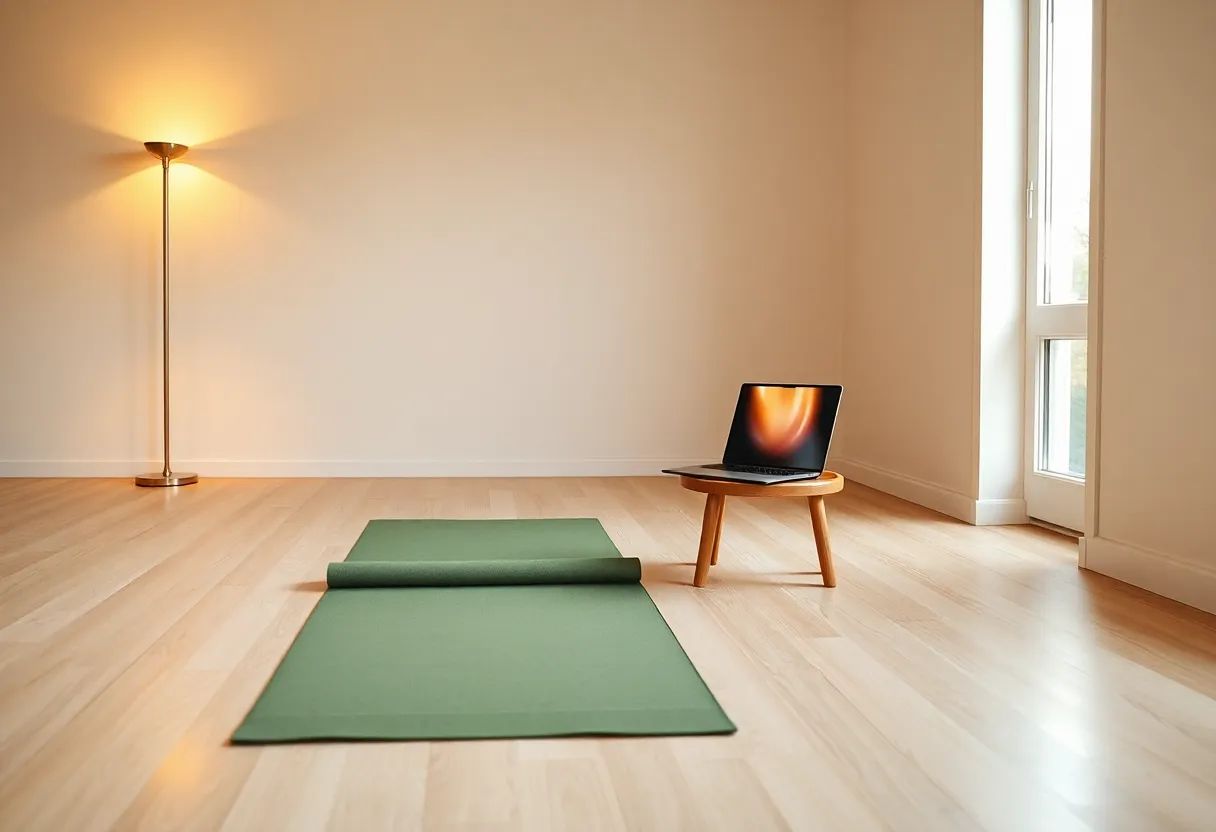
What you do need is a quiet square of floor a bit bigger than the mat, a wall nearby for balance and stretching against, and a screen you can see clearly from the floor. A laptop on a low chair works fine. A wall-mounted TV is better. A phone is what most people use, and it is the worst of the three.
How to actually start
Two thirty-minute sessions a week, for three weeks. That is the entire starting protocol. Not seven. Not one. Two.
The reason two works is that it is enough to feel a small change in your body without being so much that you dread the next session. The reason three weeks is the unit is that the body needs about that long to recognise a new shape is no longer foreign.
Pick a fixed time. Tuesday and Friday evenings, for example. Same slot every week. Resistance to a new habit collapses when the decision of when to do it has already been made.
In the first three weeks, do not chase poses. Do not try the headstand. Do not push for the splits. Watch what your body does in a standing forward fold. Watch how breath changes everything. The first three weeks are about learning to pay attention, not about flexibility.
When to bring a teacher in
After three weeks of self-led practice, most people hit the same wall. They feel something is slightly off, but cannot see what. The alignment is unclear. The breathing seems disconnected from the movement. A pose that looks fine in the video does not feel fine in the body.
This is the moment a teacher pays for themselves. One online private session, or a small group class with a teacher who watches you specifically, will fix things in twenty minutes that you would not figure out in twenty months of YouTube. A teacher who knows biomechanics will see why your forward fold compresses your lower back, where your standing pose loses its base, what your shoulders do when your arms go overhead. None of that is visible to you.
This is the most efficient way to learn. Self-led for three weeks to build the habit and the body awareness. Then a few sessions with a real teacher to fix what self-led practice cannot see. Then back to self-led with the corrections in place.
The hardest part
Showing up the second time. The first session is exciting. The second is when the resistance starts. If you can get through the first six sessions without missing one, you have built the engine that makes the next six months easy.
Most people who eventually have a home yoga practice they love started by getting that first month right. Two sessions a week, fixed time, real teacher early enough to fix the silly mistakes. The rest takes care of itself.