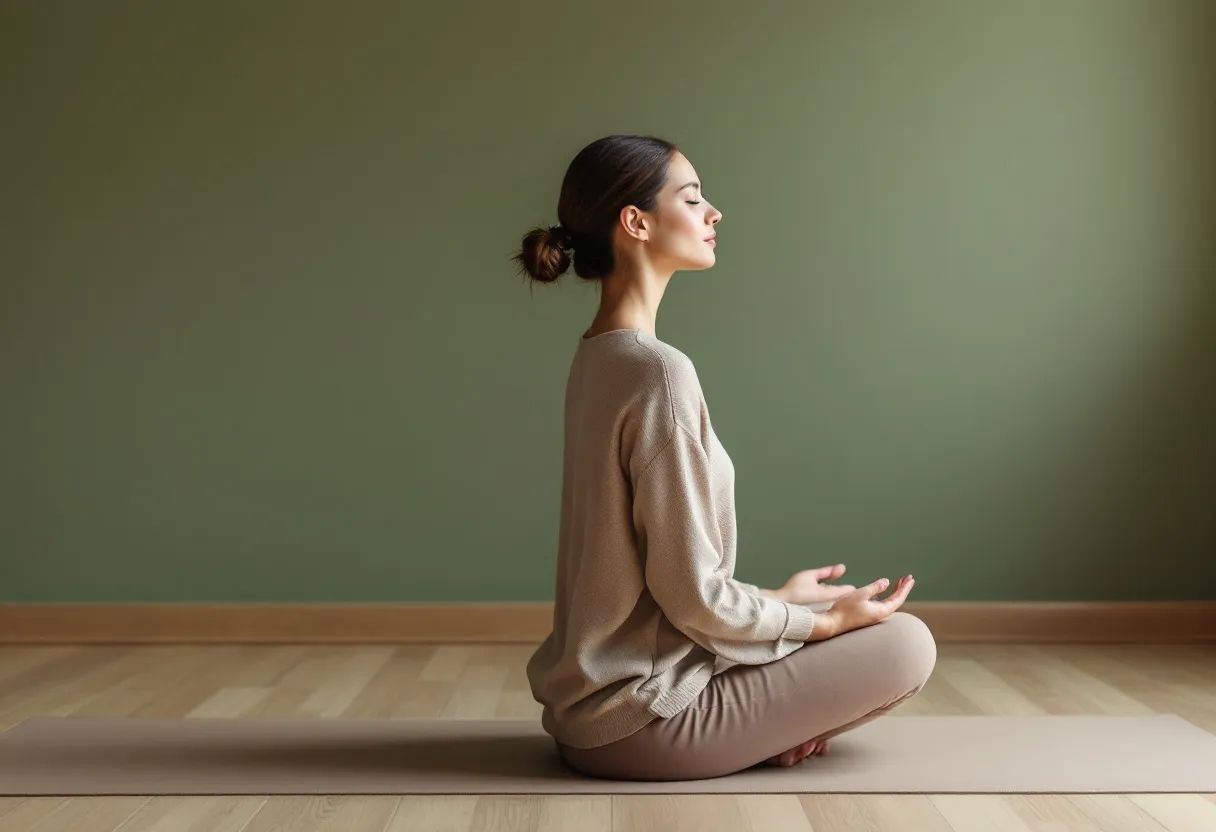
A student in one of the scoliosis classes once told me she could feel her own ribs when she lay on her back, one side rising easily with each breath, the other barely moving at all. She had never had a breathing test in her life. She did not need one to notice that her body was not breathing the same way on both sides.
That asymmetry is real, and it comes directly from how a rotated spine carries the ribs with it. Whether it adds up to actual impaired breathing, the kind a doctor would measure, is a separate question with a much narrower answer than most people assume. Here is the mechanism, and where the line actually sits.
What rotation actually does to the rib cage
A scoliotic curve is never purely side to side. As the spine bends, it also rotates along its length, and every rib is anchored to a vertebra, so the rotation drags the whole rib cage along with it. This is the same convex and concave pattern that shows up in why a scoliotic spine feels locked in a backbend, just applied to the ribs instead of the muscles around them. On the convex side of the curve, the ribs get pushed further apart and outward. On the concave side, they crowd closer together.
The rib cage inherits the same unevenness already familiar from the muscles around a scoliotic spine. One side is long and doing extra work, the other is short and stuck. A breath that expands both sides equally is asking the ribs to do something their current geometry makes genuinely harder on one side.
Why 'restricted breathing' is not automatic
A 2012 review of pulmonary function in children with idiopathic scoliosis is fairly specific about where the clinical line sits. Mild to moderate curves, under roughly 70 degrees, produce very few measurable respiratory symptoms. Lung function abnormalities generally only become detectable once a curve passes somewhere in the 50 to 60 degree range, and serious cardiorespiratory risk is mainly a concern above 90 degrees.
Most adult scoliosis falls well under those numbers. That gap matters. It means the rib cage can be genuinely, measurably asymmetric in how it moves, without that asymmetry adding up to impaired lung function in any clinical sense. Both things are true at once, and most explanations of scoliosis and breathing only give you one of them.

The asymmetry you can feel before any test would show it
A pulmonary function test measures total volume in and out. It does not measure which side of the rib cage is doing the work to move that volume. A curve small enough to pass every breathing test with a normal result can still feel, from the inside, like one side of the chest is doing most of the breathing while the other goes along for the ride.
That felt asymmetry is not something to dismiss because a test would come back clean. It is a real, local stiffness in how the ribs on the concave side are able to move, and it responds to the same kind of patient, repeated mobility work that helps a stuck hip or a locked shoulder. The goal is a rib cage that moves more evenly this month than it did last month, whatever a spirometer says.
What a breath practice can actually do here
The practical work is simple to describe and slow to build. Lying on the concave side with a folded blanket under the ribs, then breathing deliberately into the space that resists, gives the stiffer side something to expand against. A supported side-bend away from the concave side does the same thing from a different angle, lengthening tissue that has been short for years.
This is not the same as Schroth therapy, which builds an entire exercise system around one person's specific curve and uses a structured rotational breathing pattern to try to influence the curve itself. That is a dedicated clinical approach with its own evidence base. A therapeutic yoga practice offers something smaller and more general here. It offers rib cage mobility and a breathing habit that includes the side you normally skip. That happens alongside whatever medical care your curve is already receiving.
When to see a doctor before your next class
None of this is a substitute for medical monitoring, and some symptoms mean a class should wait. New or worsening shortness of breath, breathing that feels shallow even at rest, or a curve your doctor has flagged as changing quickly are all reasons to be seen before your next session, not after it. A fuller list of when to see a doctor before practising covers the general cases beyond breathing alone.
For the ordinary, mild curve that most adults are living with, none of that applies. The felt tightness on one side of the ribs is simply something to work with patiently, the same way you would with any joint that has been stiff for years.
| Curve size | What is typically true | What a breath practice offers |
|---|---|---|
| Mild, under about 30 degrees | Rib cage moves unevenly, breathing tests are usually normal | Rib mobility work, breathing into the concave side |
| Moderate, roughly 30 to 60 degrees | Some curves start to show measurable changes on testing | Same mobility work, alongside medical monitoring |
| Larger, above about 60 to 70 degrees | Measurable breathing changes become more likely | A supporting role only, under a doctor and physiotherapist |
Common questions
Can scoliosis affect your breathing?
The rotation that comes with a curved spine does change how evenly the rib cage expands, and that is true even in mild curves. Whether it adds up to measurably impaired breathing depends heavily on how large the curve is. Most adult curves are mild enough that a breathing test would come back normal.
Why does one side of my ribs feel harder to breathe into?
As the spine rotates, the ribs on the concave side of the curve get crowded closer together, leaving less room for them to move. That side can feel stiffer to breathe into even when a formal test of your total lung volume would look completely normal.
At what point does scoliosis start to actually affect lung function?
Research on idiopathic scoliosis generally finds measurable changes appearing once a curve passes somewhere around 50 to 60 degrees, with serious risk concentrated above 90 degrees. Most adult curves sit well below that range.
Can yoga improve breathing with scoliosis?
It can help mobilise a stiff rib cage and build the habit of breathing into the side that resists, which many students notice as an easier, fuller breath over time. It does not correct the curve, and it works alongside medical care rather than instead of it.
Is Schroth method better than yoga for scoliosis breathing?
They are not really competing for the same job. Schroth is a dedicated clinical system built around one person's specific curve, with its own structured breathing protocol. A therapeutic yoga practice offers more general rib cage mobility and breath awareness, and sits well alongside Schroth or standard physiotherapy rather than replacing either.
The honest answer to whether scoliosis affects breathing is that the mechanics change for almost everyone with a curve, and the clinical significance of that change depends on a number most people never ask about. Both facts can be true, and knowing which one applies to you is more useful than assuming the worst or dismissing the asymmetry outright.
The fuller framework for practising safely with a curved spine lives in the scoliosis yoga guide. If breathing has felt uneven in a way you cannot explain, that is what a one-on-one assessment is for.
It is the fastest way to find out what your specific curve is actually doing, rather than guessing from a general description like this one.