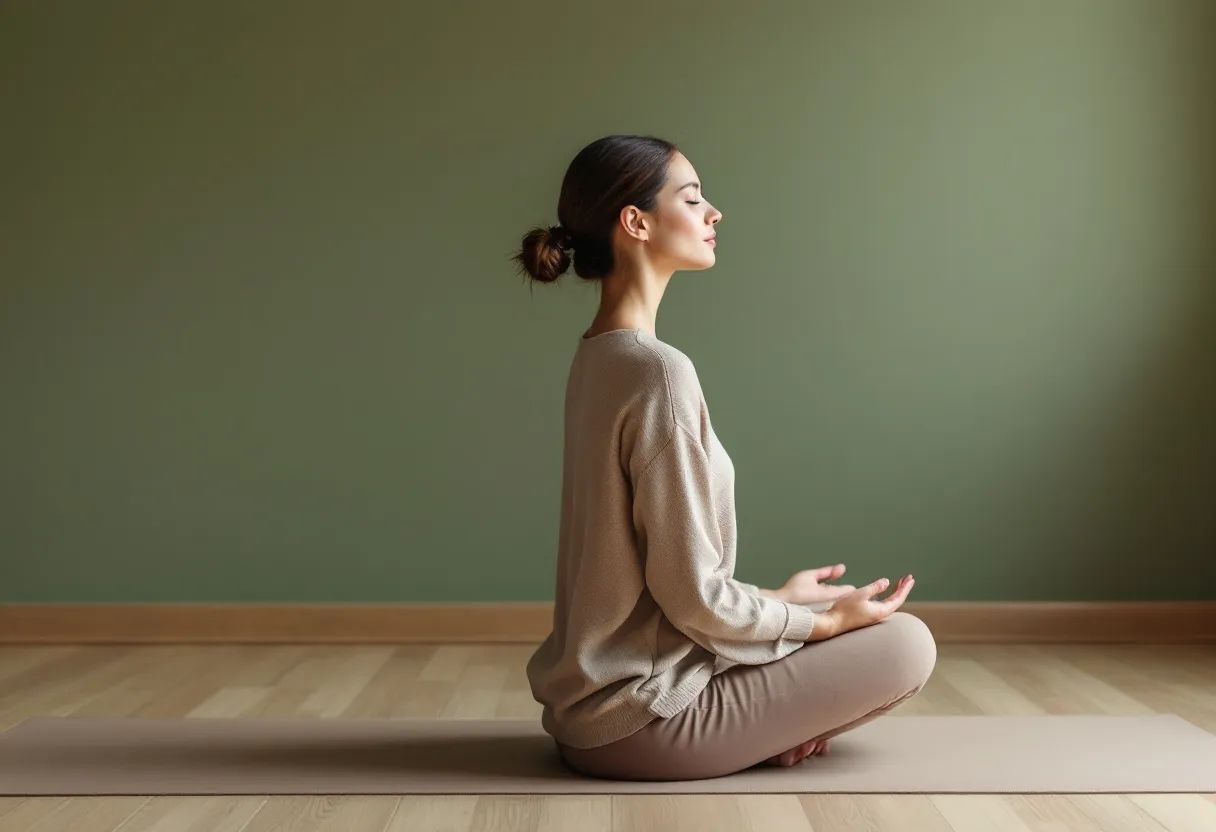
Most adults asking about scoliosis without surgery want to know one thing: whether movement does anything real, or whether it is just a way to pass the time until an operation. The honest answer is that a well-built practice can change how much your back hurts, how well you breathe, and how you carry load through an ordinary day. It does not straighten the curve. Those are two different claims, and most of what you will read online blurs them together.
I teach yoga, and I hold a PhD in mechanical engineering. That combination means I read a curved spine the way I would read any structure carrying load unevenly, rather than as a shape to be corrected. This guide is what I would tell an adult with a curve before their first class: what the diagnosis actually means, what the research does and does not cover, what is worth practising, and where your medical team stays in charge.
What counts as scoliosis in an adult?
Adult degenerative scoliosis is a sideways curvature of the spine that develops after skeletal maturity, defined as a Cobb angle of 10 degrees or more on a standing X-ray. It is far more common than most people expect. The American Academy of Physical Medicine and Rehabilitation puts the prevalence at roughly 30% of adults over 50, and up to 68% of those over 60 (last updated April 2025).
Two things follow from those numbers. The first is that a curve is not a rare misfortune, and finding out you have one at 45 does not mean something has gone badly wrong. The second is more useful: because most adult curves are mild, the number on the report is a poor predictor of how you will feel. Among my students, the person with the larger measured curve is frequently the one in less pain. The degree tells a surgeon something. It tells you much less than the way your two sides actually move.
Can yoga straighten a scoliosis curve?
No. Yoga does not correct a structural curve, and a teacher who implies otherwise is selling something. What a well-built practice can change is the pain you carry day to day, how evenly you load the two sides of your body, and how much of your ribcage you can actually breathe into. For most adults, that is the whole of what they came for.
Keeping those two claims apart matters more than it sounds. If you practise expecting the curve to reduce, you will measure the wrong thing, get discouraged by an X-ray that has not moved, and quit something that was working. If you practise expecting to move more comfortably within the curve you have, you will usually get it, and you will notice within weeks rather than years.
Why does a curved spine feel locked rather than just tight?
Because a scoliotic spine rotates as it bends. The vertebrae near the apex of the curve sit at an angle that resists a clean, even movement instead of sharing it, so the segments that can still move end up doing more than their share. That is a different problem from tightness, and stretching does not solve it. The mechanism is worked through in detail in why a backbend feels locked with scoliosis.
There is a second layer underneath the rotation. On the concave side of the curve the muscles have spent years short and working hard; on the convex side they are long and comparatively weak. A cue like "lengthen through both sides" therefore arrives as two different instructions depending on which side of your body is listening. This is why a general class can leave you feeling worse without anybody doing anything wrong: the room was taught to a symmetrical average, and you are not one.
What does the research on scoliosis exercise actually cover?
Less than the confident tone of most scoliosis websites suggests, and almost none of it is about adults. The Schroth method is the most-researched scoliosis-specific exercise approach there is. A 2023 systematic review of Schroth trials (Children, volume 10, article 954) examined every trial it could find and reported that overall methodological rigour was suboptimal, potentially invalidating evidence synthesis. Every included study was in adolescents aged 10 to 18. The reviewers identified no published trials in adults at all.
The same boundary shows up in the guidelines. The 2016 SOSORT guidelines, the reference document for conservative scoliosis treatment, are titled for the treatment of idiopathic scoliosis during growth. They are careful, well-built recommendations aimed at a spine that is still changing. If you are 40, they were not written about you.
The evidence you are being quoted is adolescent evidence. That does not make it useless to an adult. It does mean nobody should promise you a specific result from it.
I would rather say that plainly than borrow authority I do not have. What adults do have is a reasonable body of work on general exercise for spinal pain, decades of clinical practice, and the mechanics of the individual spine in the room. That is enough to work from carefully. It is not enough to promise a number.
What should an adult with a curve actually practise?
In an order, and the order is the part most classes skip. Free the joints that have stopped moving before asking anything of them under load. Then work the two sides as two different sides, giving the concave side room to lengthen and the convex side something to hold with. Then, and only then, add strength, because strength built on a joint that cannot move yet simply locks the compensation in place.
Breath belongs in that sequence rather than after it. A rotated ribcage does not open evenly, and directing breath into the side that stays quiet does more for a stuck segment than pushing the shape further ever will. On the practical questions of what to leave out and what to build toward, there are two companion pieces: the poses commonly cautioned with scoliosis and the safer swap for each, and how to deepen a backbend safely without the lower back paying for it.
| Approach | What it changes | Best for |
|---|---|---|
| Schroth or other scoliosis-specific physiotherapy | Curve-specific corrective work, taught by certified therapists | A monitored or progressing curve, most evidenced in adolescents |
| Therapeutic yoga, taught to your curve | Load distribution, breathing, day-to-day comfort within the curve | An adult managing pain and stiffness alongside medical care |
| General group yoga | Fitness and mobility, taught to a symmetrical average | A spine with no diagnosed curve |
| Massage or adjustment on its own | Short-term relief without changing how load is carried | A bad week, not a long-term plan |
| Surgery | Structural correction and stabilisation | Severe or progressing curves, decided with a spine surgeon |
The row most people underestimate is the fourth one. Relief that fades is not a failed treatment, it is a treatment aimed at the symptom rather than the load path, which is a pattern that shows up well beyond scoliosis and is covered in why your pain keeps coming back.
Where does medical care stay in charge?
Everywhere that a curve is still changing. If yours is being monitored, if you are still growing, or if you have new numbness, new weakness, or a sudden change in how the curve looks, that is a conversation with a doctor before your next class rather than after it. Sharp, specific pain belongs in the same category. It is worth knowing that few conservative treatments succeed in halting or slowing progression, even while supervised exercise is associated with reduced disability and better quality of life. Both of those are true at once, and a practice that only tells you the second half is not being straight with you.
A scoliosis-trained physiotherapist is a good partner to a yoga practice, not a competing choice you have to pick between. I would rather share a student than have her choose.
Where to start if the curve is yours
Start by finding out which of the general advice applies to you at all, because direction changes everything: a twist that eases a right-rotated curve can deepen a left-rotated one. If you want the broader orientation first, whether yoga is safe for adults with scoliosis answers that question on its own. Then bring your actual curve to someone who will look at it, rather than another article that cannot.
Common questions
Can yoga fix scoliosis in adults?
No. Yoga does not straighten or correct a structural curve at any age, and no pose or sequence should be taught as though it can. What a practice built around your curve can change is pain, breathing and how evenly you carry load, which is what most adults are actually looking for.
Is yoga safe if I have scoliosis?
Generally yes, with the caveat that a general class is taught to a symmetrical average and your spine is not symmetrical. The risk is not any single pose, it is being asked repeatedly for even movement your spine cannot produce evenly. If your curve is being monitored, check with your doctor first.
How common is scoliosis in adults?
Common. The American Academy of Physical Medicine and Rehabilitation reports roughly 30% of adults over 50 and up to 68% of those over 60 have adult degenerative scoliosis, defined as a curve of 10 degrees or more. Most curves are mild and many cause no symptoms at all.
Is Schroth better than yoga for scoliosis?
They answer different questions. Schroth is curve-specific corrective physiotherapy with the largest research base of any exercise method, though a 2023 systematic review found that research was conducted almost entirely in adolescents and was methodologically weak. Therapeutic yoga is about moving comfortably within the curve you have. Many adults reasonably do both.
Will my curve get worse if I do nothing?
That is a medical question rather than a yoga question, and it depends on your age, your curve and whether it is currently progressing. Your doctor is the right person to answer it. What is clear is that few conservative treatments reliably halt progression, so nobody should sell you movement as a way to stop a curve advancing.
Do I need a one-to-one class, or will a group class do?
A group class can work if the teacher knows your curve is there and adapts what she asks of you. What does not work is a room where nobody knows, because the default instruction is symmetrical. At minimum, tell your teacher before the first class which way your curve runs and where it locks.