Among my students, many live with scoliosis of one degree or another. The question I hear most is a quiet, slightly worried one. Can I even do yoga with a curved spine, or will I make it worse?
It is a fair thing to ask. The honest answer is that yes, you can practise, and it can help you move and breathe more comfortably. But how you practise matters more for a scoliosis spine than for almost anyone else. This is where understanding the mechanics changes everything, and it is the reason I am careful about who teaches it.
First, what scoliosis really is
Most people picture scoliosis as a spine that simply leans to one side. It is more than that. The spine curves sideways, and it also rotates, and in places the segments become stiff and locked so they no longer move evenly. One side of the body ends up compressed and tense, the other side stretched and weak.
That detail is the whole story, because it explains why the usual advice, just stretch more and you will be fine, so often backfires.
Why forcing a pose makes a curved spine worse
When a spine cannot move evenly, asking it to make an even shape is asking for trouble. Here is what happens, in three parts.
The vertebrae cannot extend evenly
In a backbend, every segment of the spine is meant to share the extension. A scoliosis spine cannot, because some segments are rotated and locked. When the stiff part will not move, a softer part nearby moves twice as much to make up the difference. That part is usually the lower back, which is how a pose that was supposed to feel good leaves you with an aching low back instead.
The two sides are not equal
On the concave side of the curve, the muscles are short and over-tense. On the convex side, they are long and weak. A symmetrical stretch, the same shape on both sides, deepens that imbalance. It frees the side that was already loose and ignores the side that actually needed support. The body does not become more even. It becomes more lopsided.
The ribcage and the breath are caught in it
When scoliosis combines with a rounded upper back, the ribcage on one side cannot open fully. Chest-opening poses then feel blocked, and the breath feels short and constrained. Forcing the chest open from the outside only pushes the work somewhere it should not go.
I had a student whose lower spine curved to the left and rotated to the right. Opening her chest felt almost impossible, and her breath felt held in. Nothing was wrong with her effort. Her ribcage simply could not move the way the pose assumed it would. Once we stopped forcing the shape and started working with her actual structure, everything changed.
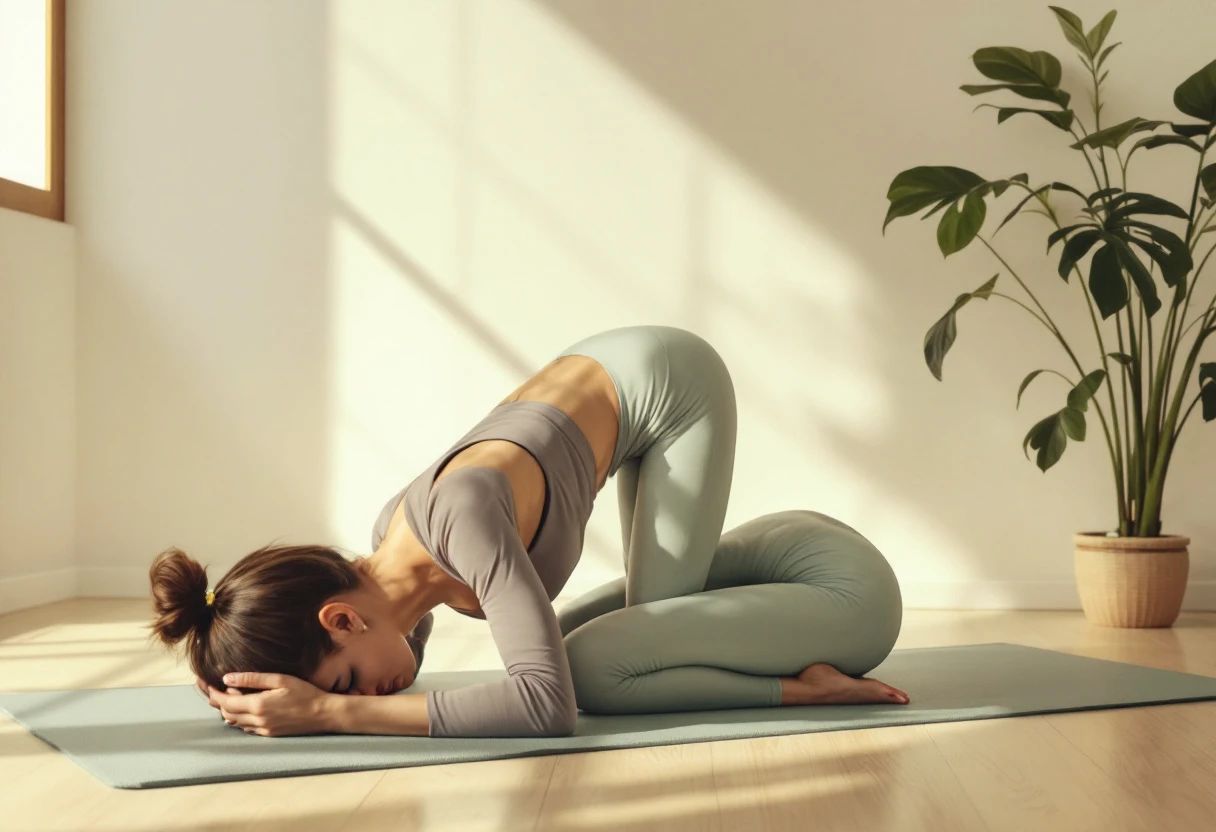
What actually helps
If forcing an even shape is the problem, the answer is to stop chasing the shape and start working with the spine you have. In practice that means a few things.
I work the two sides differently. The tight, concave side needs gentle space and length. The weak, convex side needs strength and support. Treating them as if they were the same is the single most common mistake I see.
I free the joints before asking for any stretch, so the stiff segments are invited to move rather than bullied into it. I bring in the breath and the ribcage deliberately, because breathing into the restricted side does more for a curve than any aggressive chest opener. And I build strength in the muscles that hold the spine, because a curve that is well supported by strong muscles is a curve that aches far less day to day.
The aim is not to straighten the curve. Yoga does not do that, and any teacher who promises it is not being honest with you. The aim is to help you stand taller within your own body, breathe more freely, and live with less pain. That is a realistic goal, and for most people it is a life-changing one.
This works alongside your medical team, not instead of it
Please hear this part clearly. Yoga supports a scoliosis spine. It does not replace medical care. If your curve is still progressing, if you are young and growing, or if your doctor is monitoring you, keep them in the loop. A Schroth-trained physiotherapist is a wonderful partner for this work. Think of well-guided yoga as the daily maintenance layer that sits underneath your medical care, not as a substitute for it.
It also matters that whoever teaches you understands your specific curve. A general class, however good, is built for even spines moving in even ways. A scoliosis spine needs eyes that know what to look for, and adjustments made for your direction of curve, not someone else's.
Where to start
Because no two curves are alike, the right starting point is not a class. It is an assessment. In a one-on-one session we map your curve, see how it moves and where it locks, and build a practice around the spine you actually have, online over Zoom or in person in Singapore.
If you have spent years being told to either avoid yoga or to push through it, there is a third way, and it is the one your spine has been asking for: practise with it, not against it.
For what the research on scoliosis actually covers, and where your doctor still leads the decision, the fuller scoliosis yoga guide for adults in Singapore walks through the rest.