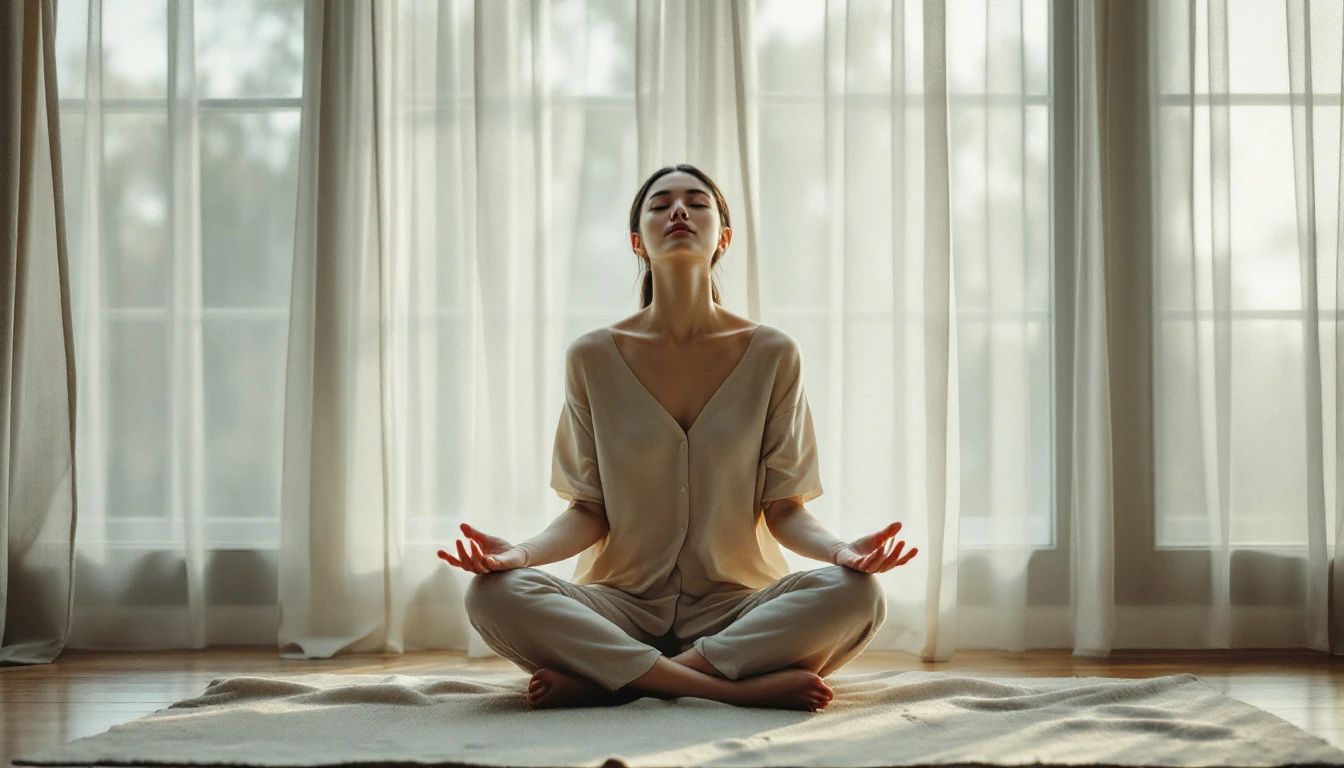
It is 4 pm on a Tuesday. You have been in back-to-back video calls since 9 am. Your shoulders are somewhere near your ears. You notice, vaguely, that you have not taken a full breath since lunch. Then a notification pops up: one more meeting in twenty minutes.
What most people do at this point is push through. What your nervous system actually needs takes about ninety seconds and costs nothing. It is a single change to the shape of your breath, and the mechanism behind it is precise enough to explain in biomechanical terms.
Why the exhale is the control lever
Your heart rate is not fixed. It rises slightly when you inhale and falls slightly when you exhale. This oscillation, called respiratory sinus arrhythmia, is governed by your vagus nerve, the main communication cable of your parasympathetic nervous system. During inhalation, your diaphragm descends, your lungs expand, and stretch receptors briefly signal your heart to speed up. During exhalation, the process reverses, the vagus nerve fires more strongly, and your heart slows.
The practical implication is that the longer your exhale relative to your inhale, the more time your heart spends decelerating. Over several breath cycles, this accumulates into a measurable shift in heart rate variability, the beat-to-beat variation that researchers use as a proxy for parasympathetic, rest-and-digest, activity versus sympathetic, fight-or-flight, activity. A higher heart rate variability during rest is consistently associated with better stress regulation and emotional recovery.
A 2023 randomised controlled study from Stanford Medicine, published in Cell Reports Medicine, compared several breathwork styles across 108 participants over four weeks. The technique that produced the greatest sustained reduction in resting respiratory rate and the greatest improvement in mood was cyclic sighing, a pattern built around a long, controlled exhale. The researchers noted that exhalation activates the parasympathetic nervous system, which slows the heart rate and has an overall soothing effect on the body.
Why your desk posture is working against you
Before the breath pattern can do its job, the body has to be able to perform it. For most desk-bound professionals, that is where things break down.
The diaphragm is a dome-shaped muscle that sits directly below your lungs, attached to the lower ribs and the upper lumbar vertebrae. When it contracts during inhalation, it flattens downward and creates negative pressure that draws air into the lungs. When it releases during exhalation, it rises back up. The rib cage needs to expand in three dimensions for this to work: outward at the sides, forward at the front, and slightly backward at the thoracic spine.
Sustained sitting with the thoracic spine rounded forward compresses exactly this space. The lower ribs drop inward and forward, the abdominal contents push up against the diaphragm from below, and the available range of diaphragm movement narrows. Research on body position and diaphragmatic function consistently shows that forward trunk flexion reduces diaphragmatic excursion, the vertical distance the diaphragm travels with each breath cycle. What you experience as a shallow breath is usually this mechanical restriction in action.
This is why chest breathing, the pattern most stressed people default to, is partly a postural problem, not merely a habit. With the diaphragm mechanically limited, the body recruits the accessory breathing muscles in the neck and upper chest instead. These muscles are short-burst muscles designed for exertion, not for twelve hours of continuous desk work. Using them all day contributes to the upper-shoulder tension and neck stiffness that most desk workers treat as a normal cost of the job.
The one pattern worth learning
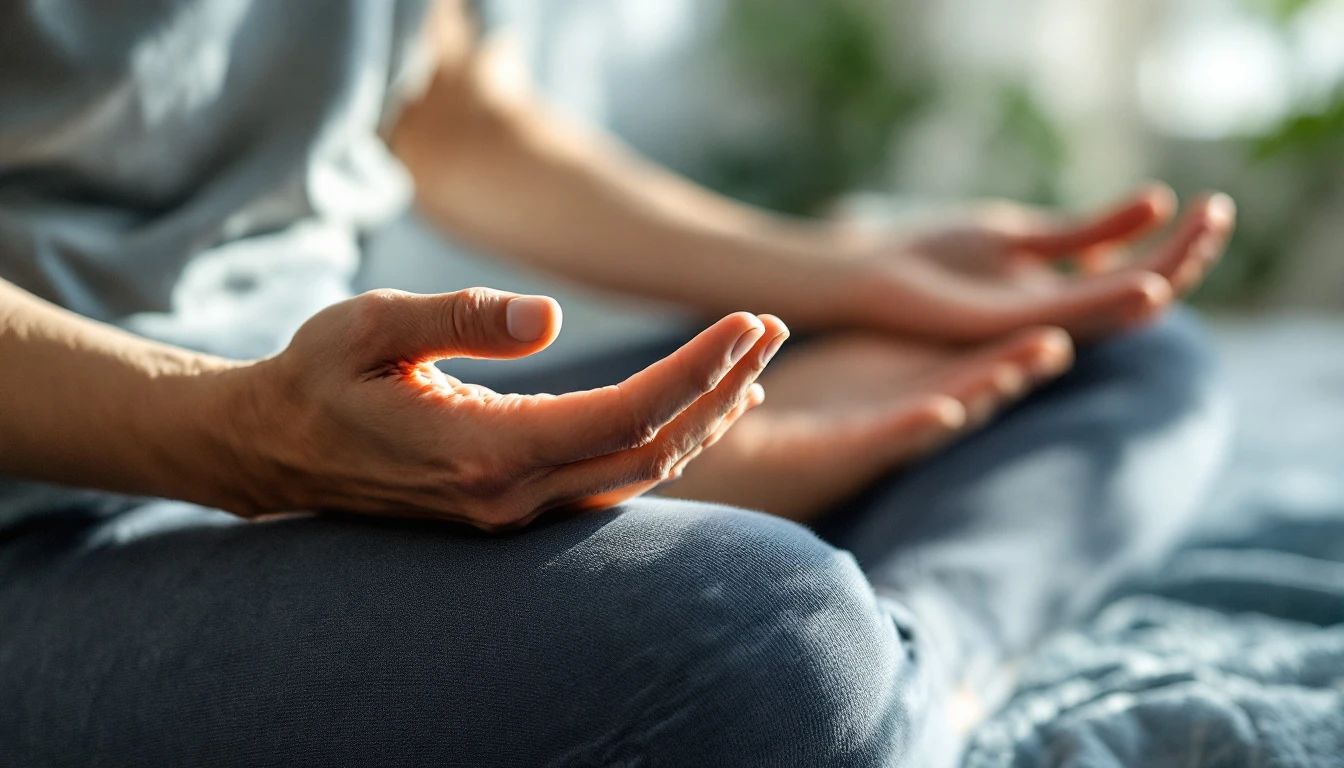
The pattern is simple. Four counts in through the nose. Six to eight counts out through the nose, slow and controlled. Repeat for five to ten cycles.
Nasal breathing matters because the nasal passages filter and warm the air, and because the sinuses produce nitric oxide, a gas that helps dilate blood vessels and supports oxygen uptake. The diaphragmatic path matters because it moves air into the lower lobes of the lungs, where blood flow is highest. Chest-only breathing reaches only the upper lobes.
A few things this pattern does not require: silence, a mat, or any particular position, though sitting or standing upright rather than slumped gives the diaphragm more room to move. You can do this at your desk, in a lift, or in the two minutes before you walk into a meeting room.
The exhale should feel like a slow, controlled release, not a squeeze. If you feel the urge to gulp air at the start of the next inhale, you shortened the exhale too quickly. Let it unwind at roughly half the speed you think it needs. Most people find the first few cycles feel slightly effortful, but by the fourth or fifth breath, the rhythm settles on its own.
When to use it
There are three moments where this pattern tends to help most for desk workers, and they share one thing in common. Each is a natural break between states.
The first is before sleep. The nervous system does not automatically switch off when you lie down. If you have been in high-output mode most of the day, sympathetic tone often stays elevated for an hour or more after work ends. Five minutes of exhale-led breathing in the dark, before you reach for your phone, helps initiate the physiological conditions for sleep, including a slower heart rate and lower cortisol.
The second is the mid-workday reset. The best time for this is between tasks, not during one. A natural break point, after finishing a piece of work and before opening the next, gives you a transition that is far more effective than trying to breathe your way through a stressful task in real time.
The third is the two minutes before a high-stakes conversation. A difficult meeting, a performance review, or a client call are when sympathetic activation tends to spike early. A few cycles of the pattern in that window can settle the physiological noise enough that you can think more clearly and respond rather than react.
Common mistakes that blunt the effect
Forcing the exhale. The exhale is mechanically passive, a release of the elastic recoil in the lungs and chest wall. Squeezing air out by contracting your abdominals hard creates tension rather than reducing it. Release slowly, do not push.
Breathing too large a volume. Calm breathing is not the same as maximum-volume breathing. Inhaling until the chest is straining and then exhaling for eight counts while running out of air is over-breathing. The inhale should be comfortable, around 70 percent of your capacity, enough that the exhale has something to release.
Holding the breath between counts. A brief pause at the end of the inhale before the exhale begins is fine. But holding after the exhale, even for a count or two, shifts the pattern toward a different physiological response. Keep the cycle smooth.
Chest-only breathing. If your shoulders rise noticeably when you inhale, the diaphragm is not doing the primary work. Place one hand on your lower ribs and one on your upper chest. The lower hand should move first and further. If only the upper hand moves, sit taller, soften the upper chest, and let the breath drop lower before you start counting.
What this supports, and what it does not
Extended exhale breathing is a tool that can help support calm and focused attention. It is not a treatment for anxiety disorders, and it does not replace clinical care if your stress is affecting your health, sleep, or function over a sustained period.
What it does reliably, when practised consistently, is give your parasympathetic nervous system more opportunity to do its job. Your autonomic nervous system is not a single gear. It is a continuous balance between activation and recovery, and most people in desk-heavy professional roles spend disproportionate time on the activation side with no scheduled recovery built in. This pattern is one way to shift that balance, available at any time, with no equipment.
Posture matters here too, and not only for the diaphragm mechanics. The therapeutic yoga approach at Inner Heal Transformation treats breath and structure as connected. The way you hold your rib cage and thoracic spine creates the conditions in which breathing either works freely or is constrained before the first count. Practising the exhale pattern alone will help. Pairing it with sustained attention to how you carry yourself over an eight-hour desk day goes further.
Where to go from here
If you have tried this pattern and found it useful, the next step is to make it a deliberate practice rather than an occasional fix. If you have found it surprisingly difficult to do without shoulder-lifting or breath-holding, that difficulty is useful information. It usually points to a combination of postural restriction and chronic over-breathing patterns that a single technique cannot fully address.
The programs page outlines the therapeutic yoga programs at Inner Heal Transformation, which include breathwork as a structured component alongside posture and movement work. If you want to understand what specifically is getting in the way of your breath before committing to a program, the free 15-minute assessment with Dr. Jacqueline Yun is where to start. It is a focused conversation to identify where the restriction sits and what kind of practice would help you most.
The breath is always available. When you lengthen the exhale, you are not forcing calm. You are creating the conditions your nervous system needs to find its own way back. 呼吸随时都在。当你延长呼气,你不是强迫平静,而是为你的神经系统创造它自己回归的条件。
Breath patterns change with practice rather than with understanding them. The first month is SGD 196 and unlimited.