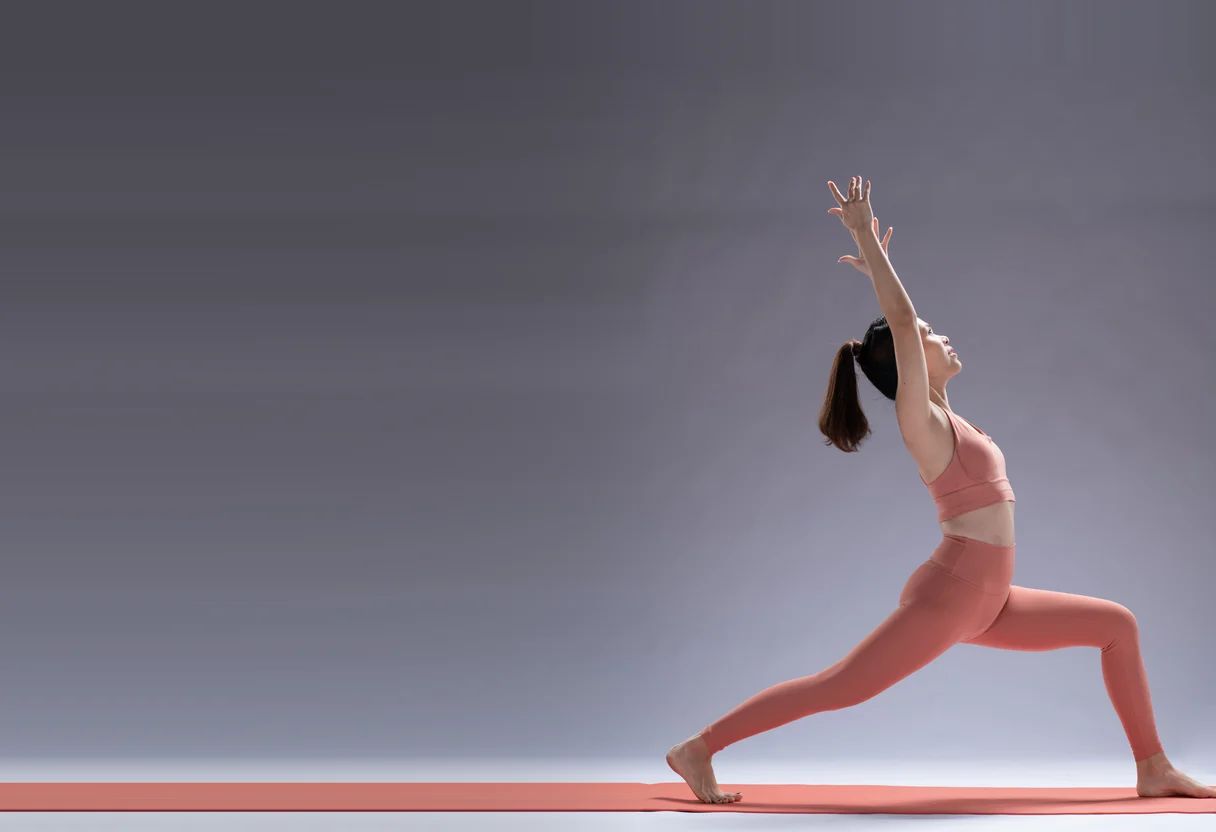
You hold a plank most mornings, sometimes past the two-minute mark. Your core is strong by any test that measures it. And by Wednesday afternoon your lower back is tight enough that you're shifting in your chair every few minutes, wondering what you're doing wrong.
Nothing, in the sense of effort. The plank was never going to reach the actual problem. A strong muscle holding a joint that hasn't moved properly in months braces the wrong thing, in the wrong order. Adding a second plank, or a heavier one, doesn't change that. Effort was never the missing ingredient. Sequence is.
Why does my back still hurt even though I exercise?
Because most of what people call core work trains one specific thing, holding a muscle contraction steady under load. It does not restore range of motion to a joint that has lost it, and it does not change which structure is compensating for which. A muscle can be strong and still be bracing a joint that is stuck, which is why the pain returns at roughly the same time of day no matter how consistent the training has been.
What planks, crunches and gym core machines are actually training
Below is what five of the most common core exercises are mechanically doing, independent of effort or consistency.
| Exercise | What it actually trains | Why it may not reach the pain | Who it genuinely suits |
|---|---|---|---|
| Planks | Isometric endurance, holding the spine still under load | Trains stillness, not the joint mobility a stiff spine needs | Good once hips and spine already move freely |
| Crunches | Repeated spinal flexion in the rectus abdominis | Repeats the flexed position a desk-bound spine sits in all day | Rarely, until the spine can flex and extend without strain |
| Sit-ups | Hip-flexor-driven flexion more than deep core engagement | Recruits the hips to do the spine's stabilising job | Almost never the right first exercise for recurring pain |
| Gym core machines | One muscle, one plane, through a fixed guided arc | Never asks the spine and hips to coordinate together | General conditioning, added after mobility and posture are corrected |
| Loaded deep-stabiliser work | Deep spinal stabilisers firing together under real load | Closest to the need, but fails if a joint stays locked | People who've already restored joint mobility and postural control |
Every row above is a strengthening exercise, and none is a mobility exercise. That gap, between adding load and restoring movement, is usually where recurring pain lives, and it's mapped out in more detail in stretching versus strengthening for back pain.
Wrong force versus right force
At Inner Heal Transformation, Dr. Jacqueline Yun calls this wrong force versus right force. Most students in pain are not weak. They are applying real, consistent force to the wrong place.
A plank asks the front of the core to hold still. If the actual restriction sits in a hip that will not rotate or a mid-back that will not extend, that force never reaches the joint causing the trouble. It gets better at holding the compensation in place instead.
This tracks with a 2016 Cochrane review of exercise therapy for chronic low back pain, which found that motor control training, the closest clinical equivalent to targeted core-stability work, is no more effective than general exercise for reducing pain over the long term. The specific exercise rarely was the variable that mattered. Sequence was.
Why the pain shows up somewhere the exercise never touched
Bodies do not fail in isolation. A hip that has been locked into a seated position for eight hours a day shifts load somewhere else the moment you stand, and it rarely shifts in a straight line. This is the crosslink Jacqueline teaches early. A locked right hip often shows up as pain diagonally, in the left lower back or the left shoulder, because force travels through the body's opposite corners more often than it travels straight up one side.
For someone who sits at a desk all day, that starting point is rarely the back itself. It's usually a hip flexor that has shortened or a thoracic spine that has rounded forward, the exact pattern behind why your back hurts from sitting at a desk all day. A plank, done faithfully every morning, does nothing to reverse either.
Joint mobility comes first, not last
Joint range comes first, because a joint that cannot move through its full range will not respond to strength work no matter how correctly it is loaded. Posture follows, retraining which joints carry load once they can actually move. Strength is added last, once there is a joint worth protecting.
The order is not incidental. Skipping straight to loaded strength work, which is what most gym core work does by default, is the pattern behind training hard and still hurting. The deeper layer Dr. Yun teaches every new student is set out in her three-element framework.
When core exercises are exactly the right tool
None of this makes planks, crunches or loaded carries the wrong exercises. It makes them the wrong first move for a body whose joints are not yet moving well, or whose posture is still funnelling load into the same overworked spot.
Once posture has been retrained as load distribution across the whole body, not corrected through willpower, core work finally has honest work to do. It reinforces a pattern that is already correct, instead of a compensation for one that isn't. That retraining process is covered on its own in how to actually retrain your posture.
Among Jacqueline's students, this usually plays out over a few months. A student comes in for pain and spends the first few weeks on hip and thoracic spine mobility and postural retraining. Load only gets added once that groundwork is done. By that point a plank reinforces a spine that already knows how to hold itself well, a very different exercise from a plank propping up one that doesn't.
Getting the sequence right
The honest answer to why the back still hurts despite regular exercise is rarely about willpower. It's about whether the exercise was ever aimed at the joint that needed to move, before asking a muscle to hold it there.
Inner Heal's approach always starts the same way. Find what isn't moving before adding force to what already is.
For some people that's enough on its own. For a back that has stayed locked into the same pattern for years, the next honest step is often deciding whether yoga or physiotherapy is the better fit for chronic back pain, sometimes alongside chiropractic care.
Effort was never the problem. Most people in pain already have plenty of it. Where that effort goes first is what gives it a real chance to work, and that ordering is the whole starting point of Inner Heal's method, finding the joint before loading the muscle.
Common questions
Should I stop doing core exercises if my back hurts?
Not necessarily. Stop the specific movement that's clearly loading a stuck or irritated joint into more of the same position, and get that joint moving properly first. Which movement that is depends on where the restriction actually sits, usually easier to identify with a trained eye than through trial and error alone. Core work becomes useful again once the sequence is corrected, not before.
Can a strong core actually cause back pain?
A strong core doesn't cause pain by itself, but a strong muscle holding a locked joint in place can make that joint feel more braced without making it move any better, which is often mistaken for progress.
What should I do instead of more core exercises?
Start with what isn't moving. A stiff hip or thoracic spine restricts how load travels through the body, and identifying that joint before adding strength work is the step most training plans skip entirely. Most generic programmes assume the spine is already moving well and simply needs to get stronger, which is rarely true for someone whose pain keeps returning.
How is wrong force different from being weak?
Weakness means a muscle can't produce enough force. Wrong force means a muscle produces plenty of force, aimed at holding the wrong joint still instead of helping the right one move. Most people who exercise consistently and still hurt fall into the second category, not the first.
Does this mean planks or crunches are bad exercises?
No. They're well-designed for what they train, endurance and flexion strength. The problem isn't the exercise. It's expecting an endurance or flexion exercise to solve a joint-mobility problem it was never built to touch.