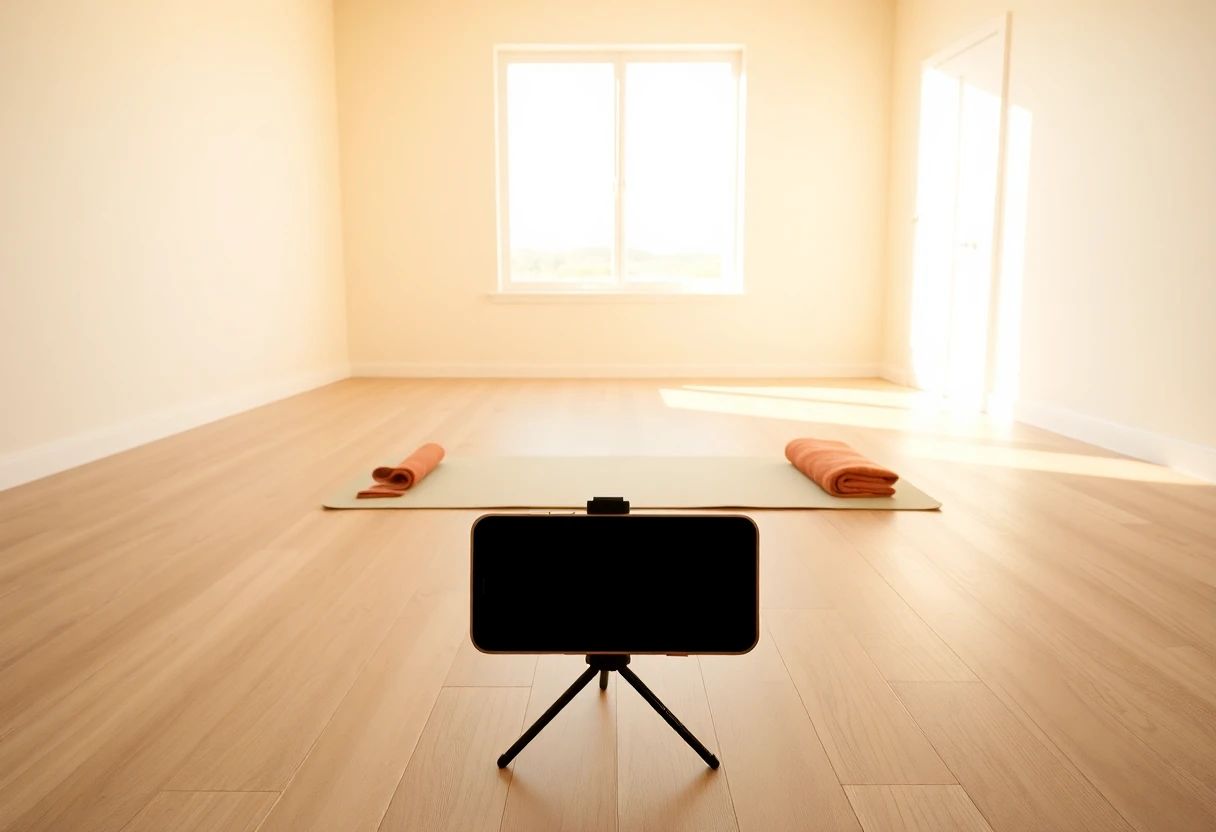
A laptop tilted back on a kitchen table catches a face and two shoulders, nothing below the collarbone. A phone propped on a stack of books three feet away catches a face and a slice of ceiling. Neither shows a teacher anything worth correcting. A camera set two and a half metres back, at hip height, framed to hold the whole body from ankle to fingertip, shows her what she would see standing across a studio floor: how the spine loads under a forward fold, whether a hip is hinging or a low back is rounding to compensate, where a knee tracks into a lunge, whether a shoulder has crept toward an ear. The difference between a Zoom class where correction happens and one where it does not is almost never the software. It is where the camera got placed, and whether anyone checked before class started.
This article maps that placement onto what actually happens in a class, what a camera shows clearly and where it genuinely runs out. The skepticism itself is reasonable. Where it usually goes wrong is assuming correction requires more from a teacher's eyes than it actually does.
Can a yoga teacher see your form over Zoom?
Yes, provided the camera is framed to show the whole body and the teacher is trained to read movement rather than count repetitions. Correction depends on gross movement patterns: how weight shifts through a standing pose, whether a spine stays long or rounds through a fold, whether a knee drifts inward on the way down, and whether the breath holds through the hardest part of a pose. None of that needs a close-up. It needs distance and a steady frame, with enough light to see an outline move clearly.
Dr. Jacqueline Yun, who has taught yoga for more than a decade after a PhD in Mechanical Engineering from NTU, reads a body the way she was trained to read a structure carrying load. That training does not change because the structure is on a screen instead of six feet away in a studio. What changes is that she has to ask for the right camera angle before class starts, and adjust her cues to work without a hand.
What a trained eye actually reads through a camera
A pose is a load-distribution problem before it is a shape. Wherever the body compensates, the same compensation shows up whether Jacqueline is standing in the room or watching a rectangle of video: a lower back that rounds to finish a range of motion the hips will not give, a knee that collapses inward because a glute is not firing, a shoulder that climbs toward an ear because the mid-back is not doing its share, a jaw that clenches when the breath gets held. A compensation reads the same size on a screen as it does across a room.
This is the layer the biomechanics behind every pose she teaches draws out for every posture, where the load is actually going and why, underneath whatever shape the pose looks like from outside. That layer does not depend on proximity. It depends on knowing what to look for, which is a training question, not a distance question.
Breath is often the clearest signal of all, and the easiest to miss if nobody is looking for it. A held breath through the hardest part of a pose usually means the body found a shortcut, bracing through the ribs instead of working the joint meant to do the job. That distinction, joint versus muscle, is close to the first thing Jacqueline checks in any student, on a screen or in a room.
Where you put the camera decides what she can correct
Camera position is not a small detail. It matters more than internet speed or which device you use, and it is the single biggest variable in what actually gets corrected in an online class. The table below is what Jacqueline asks new students to check before their first session. It is also an honest limitation list: what each position shows clearly, what it hides, and which corrections it actually supports.
| Camera position | What it shows clearly | What it hides | Best for |
|---|---|---|---|
| Side-on, full body, hip height | Spine curve, hip hinge, shoulder position | Left-right symmetry, knee tracking | Forward folds, backbends, seated twists |
| Front-on, full body, hip height | Left-right symmetry, knee alignment, shoulder height | Spinal curve depth, hip hinge angle | Standing poses, balance work |
| Overhead, mounted above the mat | Foot placement, rotation of the base | Almost everything above the hips | Checking stance width only, rarely used alone |
| Phone propped at floor level | Whatever is level with the phone lens | Most of the body above or below that height | Not recommended as the only camera |
| Laptop on a desk, angled down | A cropped, foreshortened slice of the upper body | Full-body alignment entirely | Seated breathwork only, not standing poses |
Most working online classes settle on side-on or front-on framing, switched with a verbal cue whenever a specific correction calls for the other angle. Two metres of clear floor and one steady camera is usually enough.
What a screen still cannot do
None of this closes the whole gap, and it would be dishonest to pretend it does. A camera cannot put a hand on your lower back to cue a lengthening you cannot yet feel. It cannot press two fingers into a hip crease to show you where a fold should originate. It cannot feel your ribs expand under a palm during a breath, often the fastest way to teach someone what a full breath actually feels like. It cannot catch a subtle shift in weight before it becomes a habit, the way a hand resting lightly on a hip sometimes can.
What replaces the hand is a slower kind of teaching. Instead of one touch that gets the message across in a second, there is a longer verbal breakdown paired with a demonstrated alternate angle, tried three or four different ways until one of them clicks.
It takes longer to land. For chronic stiffness and old postural habits built up over years, longer is not a real cost. These are not one-touch problems even in a studio. They unwind over weeks, whichever room the practice happens in.
There is one more real limit worth naming plainly. If a fall during a standing balance pose is a genuine risk for your body right now, a teacher in the room who can physically steady you is worth more than any camera angle. That is a small slice of students, worth naming honestly rather than pretending a screen solves everything.
What that gap looks like once it's closed
Her students put this more honestly than any marketing line would. Khoo Yin Lee, after a three-day virtual course, gave it a number rather than a superlative:
3 days virtual online class was 80% as good as in physical class.
Eighty per cent is the right answer, and it is the one worth trusting precisely because it is not a hundred. The missing portion is the hand: the touch on a lower back, the palm against the ribs. What sits inside the eighty is the part this article has been describing, and another student, Wei Wei Mah, describes the correction itself plainly, translated from her original Chinese: every time she uploads her assigned practice, the teacher reviews it and corrects her movements. The camera never became more powerful. The framing was right, and the eye reading it was trained to catch what mattered.
Deciding if this is the right fit for your body
None of this means online is automatically right for every body or every week. If you are in acute pain, in early post-surgical recovery, dealing with a real balance risk, or unsure whether it is safe to move at all, start in person. Those are among the real cases for when you actually need to be in the same room as a teacher. Once you have a baseline and clearance to move, coming back online for the long maintenance work usually fits better, and much of that is about your calendar, not your body.
It is also why online sessions fit a busy working week in a way a fixed studio schedule rarely does. If what you are weighing is the teacher rather than the format, a three-question scorecard for judging any yoga teacher is worth reading before committing to anyone, Jacqueline included. Inner Heal Transformation teaches its classes online by default because the correction holds up on a screen, and the format is what gets a body to show up week after week. The question was never really about Zoom. It was whether the person on the call knows what to look for, and says so plainly when a screen cannot do the rest.
Common questions
Can a yoga teacher really tell if my alignment is off through a webcam?
Yes, as long as the camera shows your whole body from a fixed distance. What a teacher checks for, gross patterns like a rounding low back or a knee drifting inward, is visible from across a room and just as visible on a properly framed screen.
What if my internet lags or the video freezes mid-pose?
Rarely a problem. Correction depends on a pattern building across several breaths, not one frame, so a short stutter does not erase what she needs to see. A connection unreliable enough to cut out for long stretches is worth fixing before class, the same way you would fix bad lighting.
Do I need a tripod, ring light, or special equipment to be corrected properly?
No. A phone or laptop propped at the right height and distance works fine. Placement matters more than equipment: far enough back to show your whole body and roughly level with your hips, not your face.
Which poses are genuinely harder to correct online than in person?
Anything needing a small internal rotation a camera cannot resolve, or a pose where a single touch would normally do the job in seconds. Deep hip work and subtle spinal rotations take longer to correct on screen, not impossible, just slower.