Suetan Suk Yin's doubt was practical, not abstract. She had never done a single yoga class, and she could not picture how a teacher on the other end of a video call was going to catch anything worth correcting in a body the teacher had never stood next to.
I was sceptical. How would the teacher guide and correct me? I had no yoga foundation at all, so how would I know if I was doing it right?
In the end she signed up anyway. Two days in, her husband started asking why he kept hearing the teacher call her name across the room: Xiao Ying, lift your hips higher, Xiao Ying, squeeze your arms tighter. By the end of that second class, he could see for himself that her shoulders weren't as stiff anymore. The real question underneath the skepticism is narrow and mechanical: can a teacher looking at a rectangle of video catch what she would catch standing in the room, and correct it before it becomes a habit.
Does online yoga really work?
Yes, for most students, most of the time. Correction depends on gross movement patterns: whether a spine rounds through a forward fold, whether a knee drifts inward in a lunge, whether a shoulder creeps toward an ear, whether the breath holds through the hardest part of a pose. None of that requires a teacher standing an arm's length away. It requires a full-body camera frame with decent light, and a teacher trained to read a body rather than count repetitions.
Dr. Jacqueline Yun, who has taught yoga for more than a decade after a PhD in Mechanical Engineering from NTU, reads a body as a load-distribution problem before she reads it as a shape. That read does not change because the body is on a screen instead of six feet away. What changes is smaller than most skeptics assume: she has to ask for a specific camera angle before class starts, and she has to teach with words and demonstration in the places a hand would normally do the work.
Where the honest answer gets more complicated is touch. A camera cannot press two fingers into a hip crease, or rest a palm against a ribcage to show what a full breath feels like. That gap is real, and it does not close just because everything else does.
Two students who didn't believe it either
Suetan Suk Yin is not alone in describing this exact arc. Khoo Mei Fong had already tried online yoga once and walked away certain it did not work.
I'd taken online yoga before and told myself I'd never do it again. It was hard to focus, and the teacher couldn't see your movements clearly.
What changed her mind was not a faster internet connection. Before her first class with Jacqueline even started, an assistant checked that every student's camera actually showed their whole body.
I was wondering whether she'd even be able to see each of us clearly, but no! Before class even starts, the assistant checks that every camera can see your full body. So thorough!
Accountability tells a similar story. Wendi Yang took an online front-split course and named, unprompted, the exact thing online classes are assumed to lack.
Even though this is an online course, the daily interaction and comments keep the students accountable and motivated!
None of these three students set out to prove anything about online teaching. They were each describing what changed their own mind, after their own doubt, in their own words. That is a different kind of evidence than marketing copy, and it is the only kind worth trusting on a question this specific. Between them, these three students covered most of the reasons anyone doubts this format, and all three describe the same reversal happening within days, not months.
What a skeptic actually expects to lose
Before trying it, most of what people worry about losing falls into five things: real correction, accountability, the atmosphere of a room full of people working hard, a teacher's hands, and the community of showing up to the same place every week. Some of that worry is misplaced. Some of it is exactly right. The table below draws directly from what the three testimonials above actually describe, and from where the format has a real, permanent limit.
| What you expect to lose | What actually happens online | What's genuinely lost |
|---|---|---|
| A teacher who can actually see your form | The same named, full-body corrections as a studio class | Little to nothing, if the camera is framed properly |
| Motivation without a studio to physically walk into | Daily homework review and comments most studios never offer | Nothing structural, mostly your own follow-through |
| The energy of a room full of people working hard | A live cohort meeting at the same time each week | The ambient hum of other bodies breathing nearby |
| Physical correction when words alone won't land | Slower verbal cueing, tried from two or three angles | The one-touch cue that lands in a single second |
| Knowing classmates, chatting before and after class | A recurring cohort and a teacher who remembers your name | Running into someone at the mat rack afterward |
What a screen still can't do
None of this closes the whole gap, and pretending otherwise would undercut everything above it. A camera cannot put a hand on a lower back to cue a lengthening a student cannot yet feel alone. It cannot press against a ribcage to show what a full breath feels like from the inside. Exactly where a teacher's eye can still catch a fault over Zoom and where it genuinely needs more time is worth reading before assuming either extreme.
Naming that limit plainly is what makes the testimonials above worth trusting in the first place. Nobody in them claims the screen disappeared. Each describes a narrower, more specific gap than the one they walked in fearing, which is more useful to know than a blanket yes.
There is a second honest limit worth naming. If a fall during a standing balance pose is a real risk this month, or a pain is new and has not been checked yet, in-person comes first. No format changes that. Exactly when you need to be in the same room as a teacher is a shorter list than most people expect. Suetan Suk Yin and Khoo Mei Fong were both managing ordinary stiffness and old habits, not acute injury. That distinction decides the format question more than any camera ever could.
Where this fits if the doubt was never really about the camera
Sometimes the hesitation was never really about Zoom at all. If the real question is whether a short session between meetings can amount to anything, why a packed week still has room for online yoga answers that on its own terms. If the real question is what actually stops a pain from returning once class ends, that has more to do with the three-part fix behind pain that keeps coming back and the three-element framework underneath it than with any screen.
Either way, judge the actual teacher before judging the format. A three-question scorecard for doing exactly that applies to any teacher under consideration, not only this one. This is why Inner Heal Transformation defaults to teaching online: the correction holds up, and turning up regularly is what actually changes a stiff hip or a locked shoulder, not the room it happens in. The doubt was reasonable. It was just aimed at the wrong variable.
Common questions
Is online yoga as effective as in-person yoga?
For most people managing everyday stiffness or recurring pain, yes. The gap that remains is touch, a teacher's hand cueing a movement a student cannot yet feel alone. For acute injury or pain that has not been assessed, start in person.
How does a teacher correct your posture if she can't touch you?
Through a full-body camera frame and verbal cueing, demonstrated from a second angle when the first doesn't land. It takes a sentence or two longer than a single touch would, not a different outcome.
Will I actually stay motivated without a studio to walk into?
Students who doubted this the most describe the opposite: named corrections in a live class and a recurring cohort that notices when someone is missing. A scheduled class with real classmates present functions differently from a self-paced video library, and that difference is most of what accountability actually means here.
What should make me choose in-person over online?
Acute pain, early post-surgical recovery, a genuine fall risk in balance poses, or a strong personal preference for sharing a room with a teacher. Outside those, online usually holds up.
Do I need special equipment to be corrected properly online?
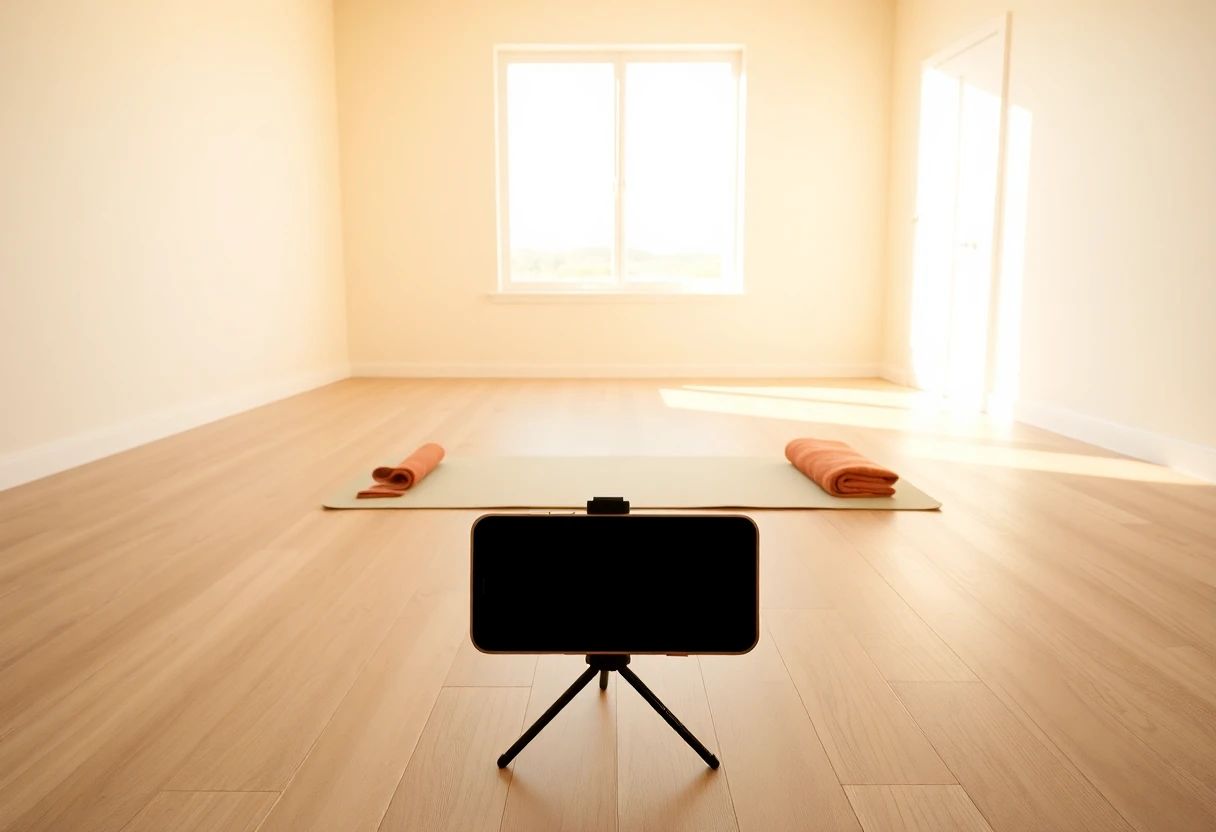
A mat and a clear patch of floor are enough. The camera just needs to sit far enough back and roughly level with your hips, not your face.