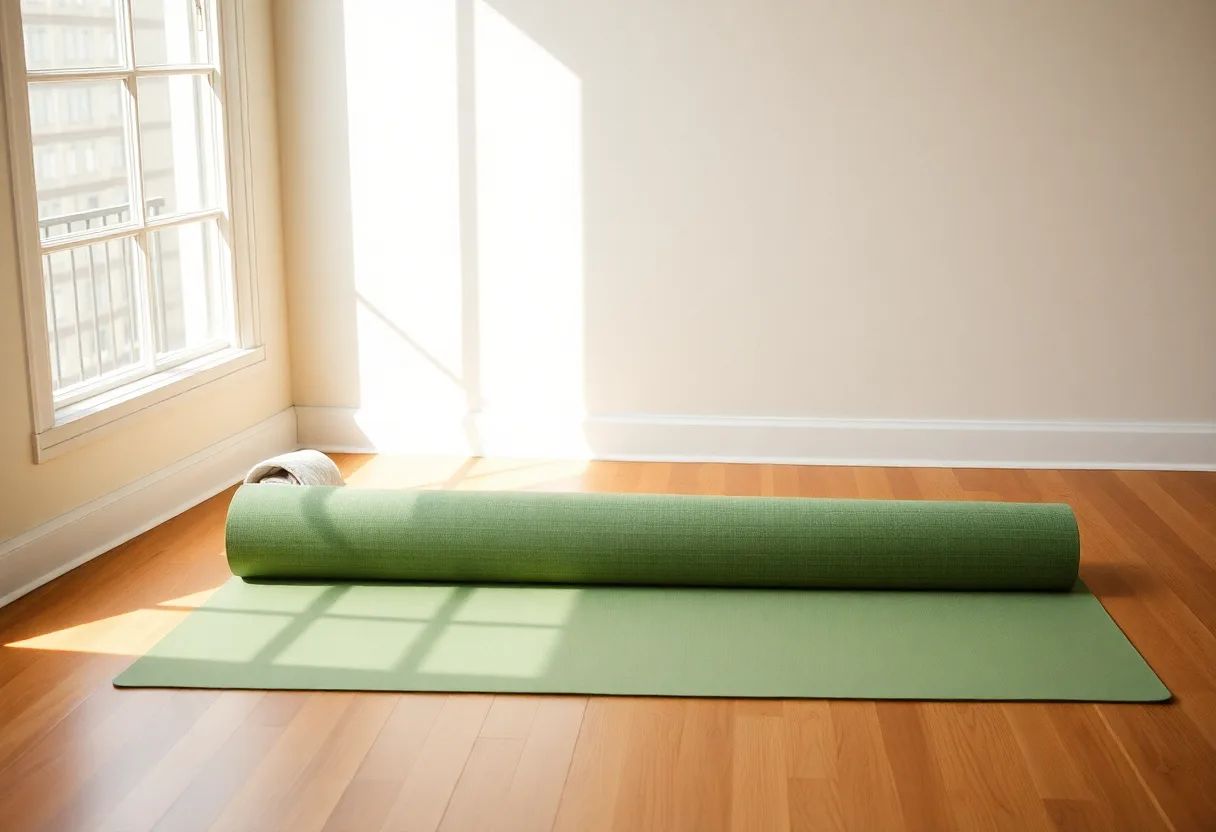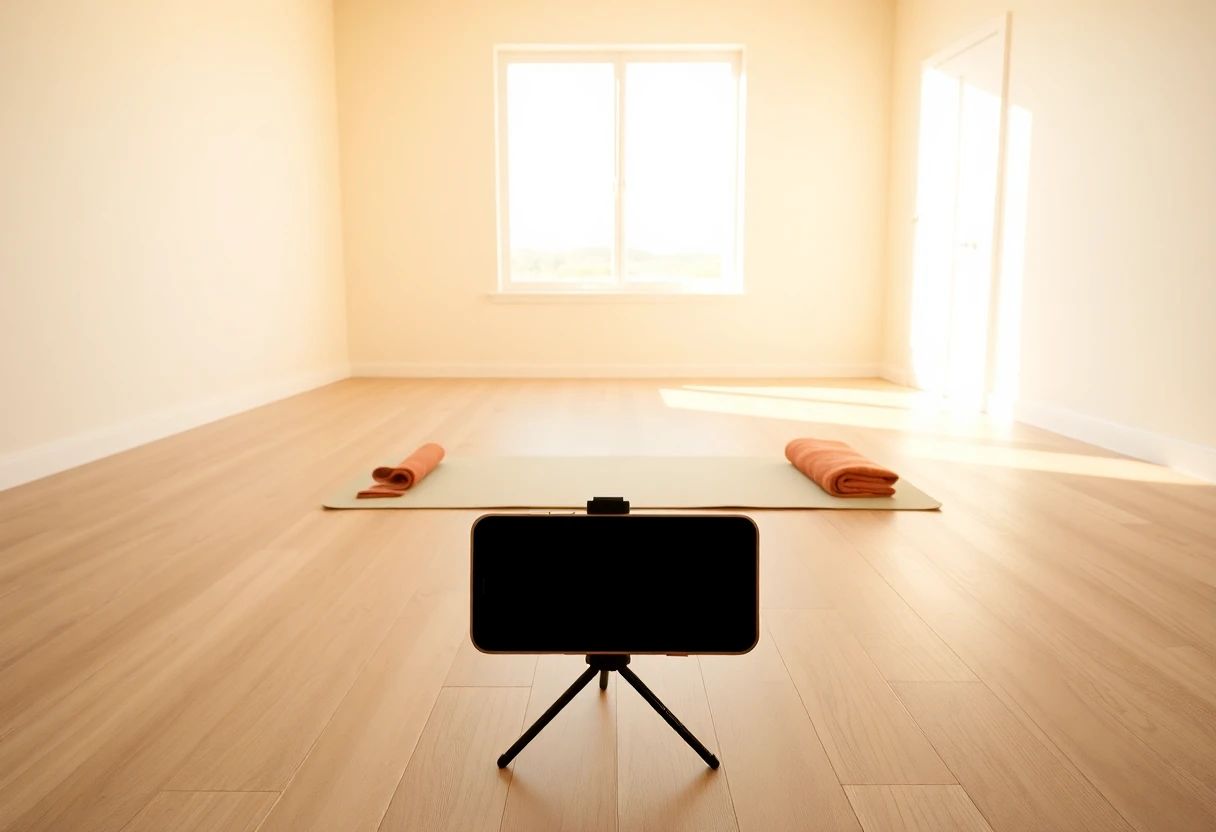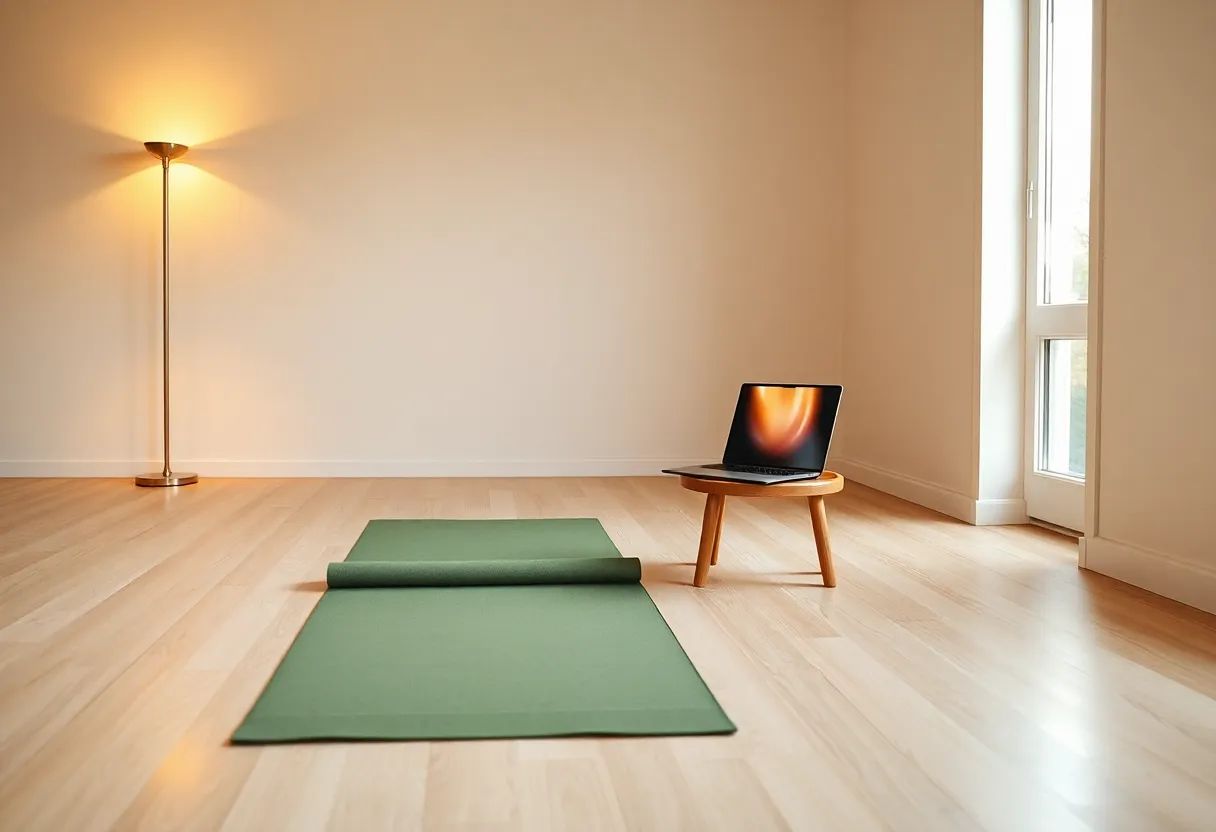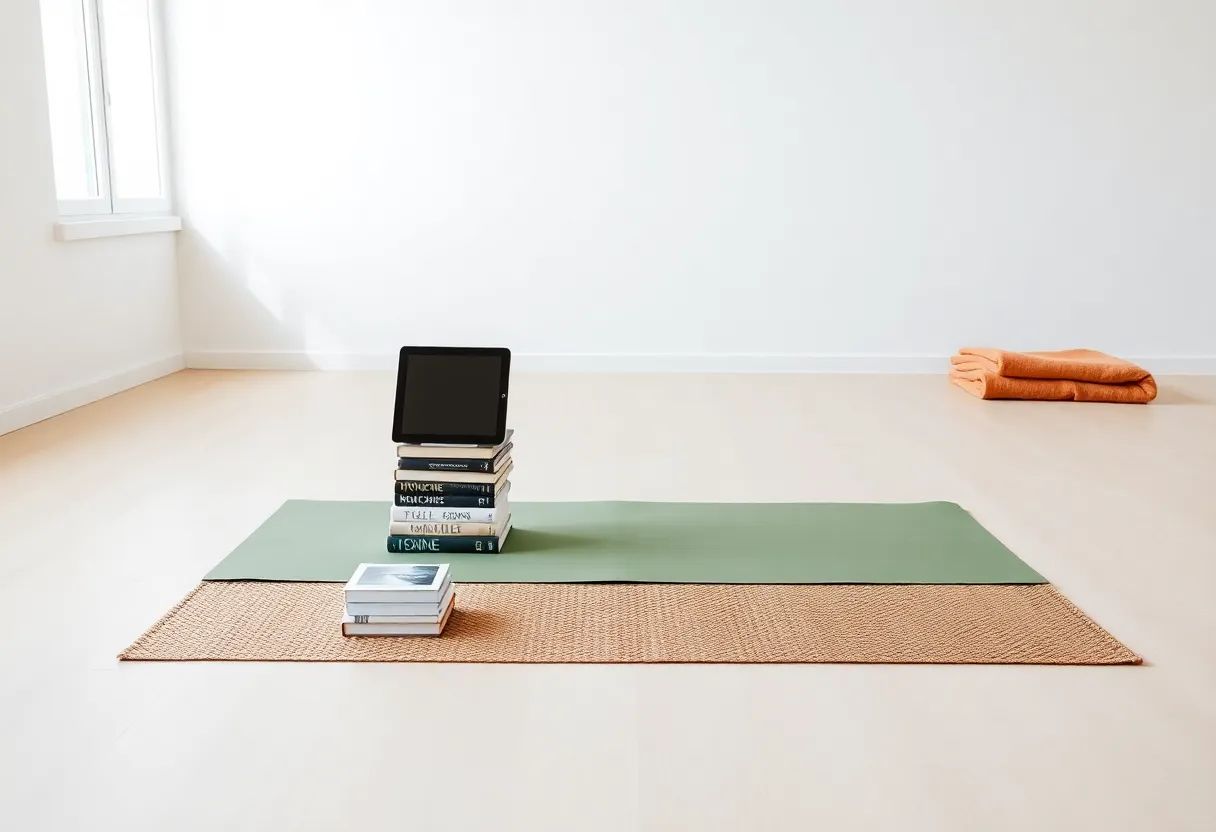
Four square metres of floor between a bed and a wardrobe, in a rented room in Toa Payoh. That is the entire footprint one Inner Heal Transformation student practises in twice a week, camera propped on a stack of paperbacks, phone charger stretched across the floor because the socket sits nowhere near the desk. Nobody would call it a studio. It works anyway.
The room does not need to look like a studio, and it does not need new equipment. It needs four things a therapeutic class actually depends on: enough space to move without hitting furniture, a camera position that shows your whole body, light that falls on you rather than behind you, and a floor that holds still under your feet. Most people already have all four before they ever book a session with Dr. Jacqueline Yun.
Why a therapeutic class asks more of your room than a follow-along video
A follow-along video only has to solve one direction. You watch the screen and copy the shape you see. Nobody is watching you back. A live therapeutic class runs the other way. The value of the session is that Dr. Yun can see what a recording never could: a shoulder creeping toward an ear, weight sitting in the wrong hip, a knee tracking past the toes, and she can correct it while you are still inside the pose, not afterward, once the moment to fix it has already passed.
She trained first as a mechanical engineer, PhD in hand, before she ever taught a yoga class, and more than a decade of teaching hasn't changed how she reads a body. She is looking at load paths, where the weight is travelling through you and where it is leaking out through a compensation instead. That is a narrower question than whether online or in-person yoga suits you better overall, a comparison worth its own answer.
None of that requires a home studio. It requires a setup that doesn't hide the information she needs, and that turns out to be a much lower bar than most people assume before their first class.
How to set up for online yoga at home
Setting up for online yoga at home comes down to four things: clear floor space to fully extend in every direction, a camera angled to show your entire body rather than a headshot, light that falls on you instead of behind you, and a stable surface underfoot. None of it needs a dedicated room. A cleared corner of a living room or a bedroom does the job just as well.
A laptop, tablet or phone propped against something sturdy works as well as a mounted camera. What matters is the angle, not the device, and once it is set up correctly the first time, repeating it before every class takes under five minutes.
Camera position: how she actually corrects you through a screen
The exact angle that works best is its own subject, covered in full in a walkthrough of how camera correction works over Zoom. The short version: a side-on or three-quarter angle that keeps your whole body in frame beats a straight-on close-up almost every time, because the curve of your spine and how a knee tracks both read clearest from the side, not face-on.
It is also why every student's frame gets checked before class starts, not after.
I was wondering whether she'd even be able to see each of us clearly, but no! Before class even starts, the assistant checks that every camera can see your full body. So thorough! Khoo Mei Fong, Inner Heal student
That check, done before the first pose, is what turns an ordinary laptop camera into a teaching tool instead of a recording of yourself getting a pose wrong alone.
The floor and surface under you
Floor matters because a therapeutic class asks you to feel exactly where your weight sits, and that sense gets harder to trust on a surface that shifts under you. A rug that bunches under a standing foot, or a floor slick enough that a downward-facing dog slides forward mid-breath, is a safety issue before it is a technique issue.
If a surface ever feels unstable, the right response is to stop and reset, not push through the shape. None of this calls for new flooring. On hardwood or tile, an ordinary mat is enough grip. On carpet, a thin mat or a firm towel laid where the hands and feet land solves most of the instability in one move.
Light: what she needs to see
Correction depends on being able to read your outline, so light matters more than most people expect, and it costs less than they assume it will. A window or a lamp facing you does the job. A ring light does not add anything a therapeutic class actually needs.
The one setup mistake worth avoiding is sitting with a bright window directly behind you. It turns your whole body into a silhouette, and a silhouette has no spine to correct. Facing the light, rather than having it at your back, fixes this without moving anything else in the room.
The room constraints people actually have
Most students aren't practising in a purpose-built room. They are working around a narrow rental, a carpeted living room, a flat with no wall space to spare, or a household that doesn't stop moving just because class has started. None of that disqualifies a room from working.
| Room constraint | Why it matters here | Cheapest fix |
|---|---|---|
| Narrow room | A cropped side view hides hip and spine alignment | Turn the mat diagonally for extra length |
| Carpet or soft flooring | Dulls the foot's sense of the ground | Lay a thin mat or towel underneath |
| Low light | A silhouette has no spine to correct | Sit facing the light, not away from it |
| Shared space | Interruption breaks the attention correction needs | Book a 45-60 minute window and close the door |
| No wall space | Some cues use a wall as a reference line | A closed door works the same as a wall |
None of these require new furniture, a bigger flat, or a shopping trip. Each one gets solved with something already in the room.
None of this is about building a home studio. It is about giving Dr. Yun the same view she would have standing in the room with you. Nothing more elaborate than that.
Setup is the smallest part of what makes a session with Inner Heal work, which is rather the point. Once your room can show your body clearly, the rest can do its job, from why online yoga fits around a busy working week to what actually makes a class therapeutic rather than just a stretch.
Common questions
Do I need a special mat for an online therapeutic class?
No. Any mat with enough grip to stop your hands and feet sliding works. If your only mat is thin or worn smooth, lay a towel underneath at the point where your feet or hands land.
What if my room is too small to fully stretch out?
Turn the mat diagonally, corner to corner. Most rooms gain thirty to forty centimetres of usable length this way, often enough to turn cramped into workable.
Does my internet connection need to be fast?
Stable matters more than fast. A video call needs a steady signal rather than a high-speed one, so sitting closer to the router or connecting with a cable solves most issues before class even starts.
What if I share the room with family or flatmates?
A closed door and a heads-up about the class time cover most of it. The correction that makes a class therapeutic depends on your own attention, not on a silent house.
Can a small bedroom really work for a therapeutic class?
Yes. Most Inner Heal students practise in an ordinary bedroom or a shared rental, not a studio. What matters is that Dr. Yun can see your whole body clearly, not how large the room is.
What if the lighting in my room changes during the day?
Check your setup around the time your class actually runs, not at midday. A spot that's bright at noon can be dim by early evening, so testing the exact hour you'll practise avoids surprises.