In 2013, Dr. Jacqueline Yun finished a PhD in Mechanical Engineering at NTU, a discipline built around tracing how load moves through a structure and where a joint or a weld starts to fail once it carries more than its share. She teaches yoga now, and on a Zoom call to an ordinary living room, or a hotel room on a work trip, she reads a body the same way, as a structure carrying load rather than a shape to imitate. Not whether a downward dog looks right. Where the weight in it is actually going.
That question is also the honest answer to whether an online yoga class is worth a busy professional's time in Singapore. The screen was never really the obstacle. The compensations a teacher watches for, a rounding low back, a shoulder creeping toward an ear, show up the same way on a camera as they do across a studio floor. This piece is about what changes when correction happens through a screen, and what does not. It is also about why the format has ended up fitting a packed Singapore work week better than a fixed class at a fixed studio ever did.
Is an online yoga class actually worth it in Singapore?
Yes, for most people, most of the time, and the reason has less to do with technology than most skeptics expect. Correction in a therapeutic class depends on gross movement: a spine rounding through a forward fold, a shoulder climbing toward an ear under load. None of that requires a teacher standing close enough to touch you. It requires a full body in frame with decent light, and years spent learning to read a body's compensations rather than its shapes.
Plenty of her students started out exactly this doubtful, certain a screen would blunt whatever correction they were paying for. Whether online yoga really works is best answered in their own words, not a sales pitch, and that arc is covered testimonial by testimonial in a piece of its own.
What a class with Inner Heal actually looks like
A live class opens with a detail most first-timers do not expect. Before a single pose starts, an assistant checks that every student's camera actually shows their whole body, not a floating head and shoulders cropped at the collarbone. That check is what turns an ordinary laptop camera into something a teacher can actually work with for the next hour.
From there, a class runs the way a good studio session would. Dr. Yun watches for the same compensations across every student's frame, a low back rounding to finish a fold the hips will not give, a knee collapsing inward on a lunge, a breath held through the hardest part of a pose. Corrections are named out loud, by name, in the moment they happen, not saved for a private note after class. A student uploads a short clip of homework between sessions, and it comes back with specific notes on what to adjust, not a generic thumbs up.
The real objection: can she see me over Zoom?
The objection underneath "does online yoga work" is narrower than it sounds. It is not really about yoga at all. It is a specific, mechanical claim: a teacher who has never stood in the room with you, reading a fault through a rectangle of video, in time to correct it before it becomes a habit.
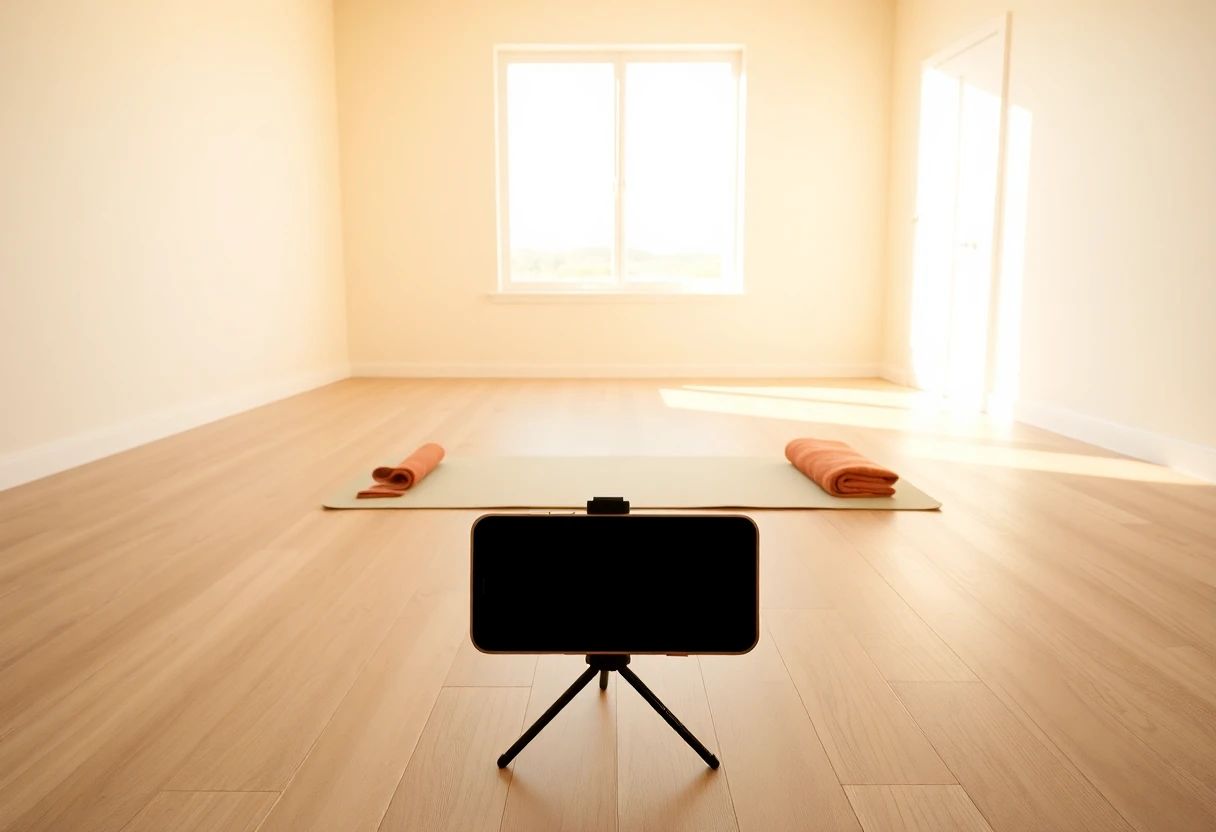
Camera position decides most of this, more than internet speed or which device is propped where. A full body in frame, held roughly level with the hips rather than the face, shows the same compensations a studio teacher would be scanning for from across a room. An engineer's habit of tracing where load actually travels through a structure carries over onto a screen without needing proximity. It needs knowing what to look for, which is a training question, not a distance one.
It is also why every class, online or in the same room, still runs on the three-element approach she teaches every new student, adapted for a camera rather than replaced by one.
Her students describe the same reversal often enough that it stops reading like a coincidence.
Zoom yoga better than in-person class! Laraine Ng, Inner Heal student
That line followed a longer list of things she had expected a screen to make worse, not better. Exactly which camera angle catches which fault, and which pose calls for a different one entirely, is worth its own answer, covered in full in a walkthrough of how a teacher actually corrects posture over Zoom.
What a screen still cannot do
None of this closes the whole gap, and it would undercut everything above to pretend otherwise. A camera cannot press two fingers into a hip crease to show where a fold should originate. It cannot rest a palm against a ribcage to show what a full breath feels like from the inside. What replaces the hand is a slower kind of teaching, a longer verbal breakdown paired with a demonstrated angle, tried more than once until it lands.
For chronic stiffness and postural habits built up over years, that extra time is not a real cost. These were never one-touch problems even in a studio. They unwind over weeks regardless of which room the practice happens in.
When starting in person is the right call
There is a second, separate limit worth naming plainly. A pain that is new and has not yet been assessed calls for an in-person session first, and the same caution applies fresh out of a joint or spinal surgery. If a real fall during a standing balance pose is a genuine risk this month, no camera changes that calculation either.
Outside those specific cases, the list of when online genuinely falls short turns out shorter than most people expect walking in. Exactly when online and in-person yoga call for different answers is worth reading before assuming either extreme.
Setting up a room that is good enough
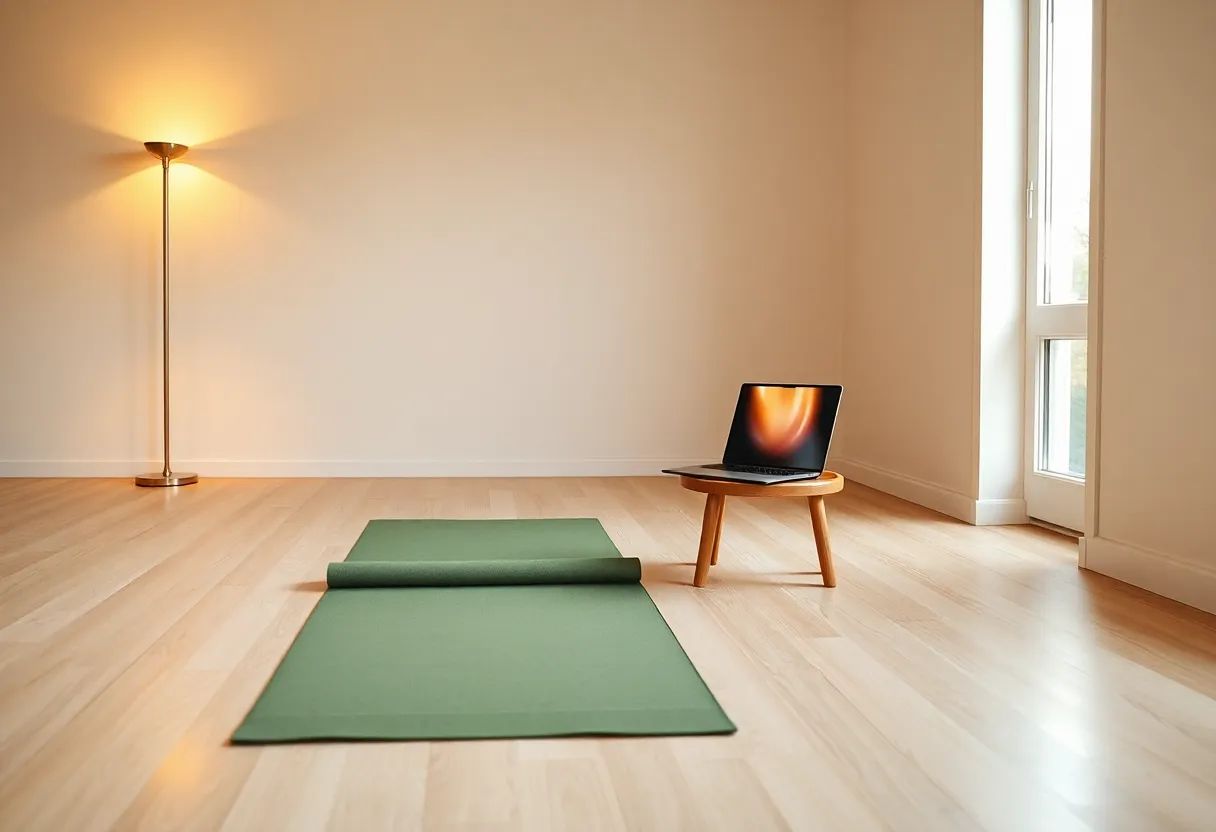
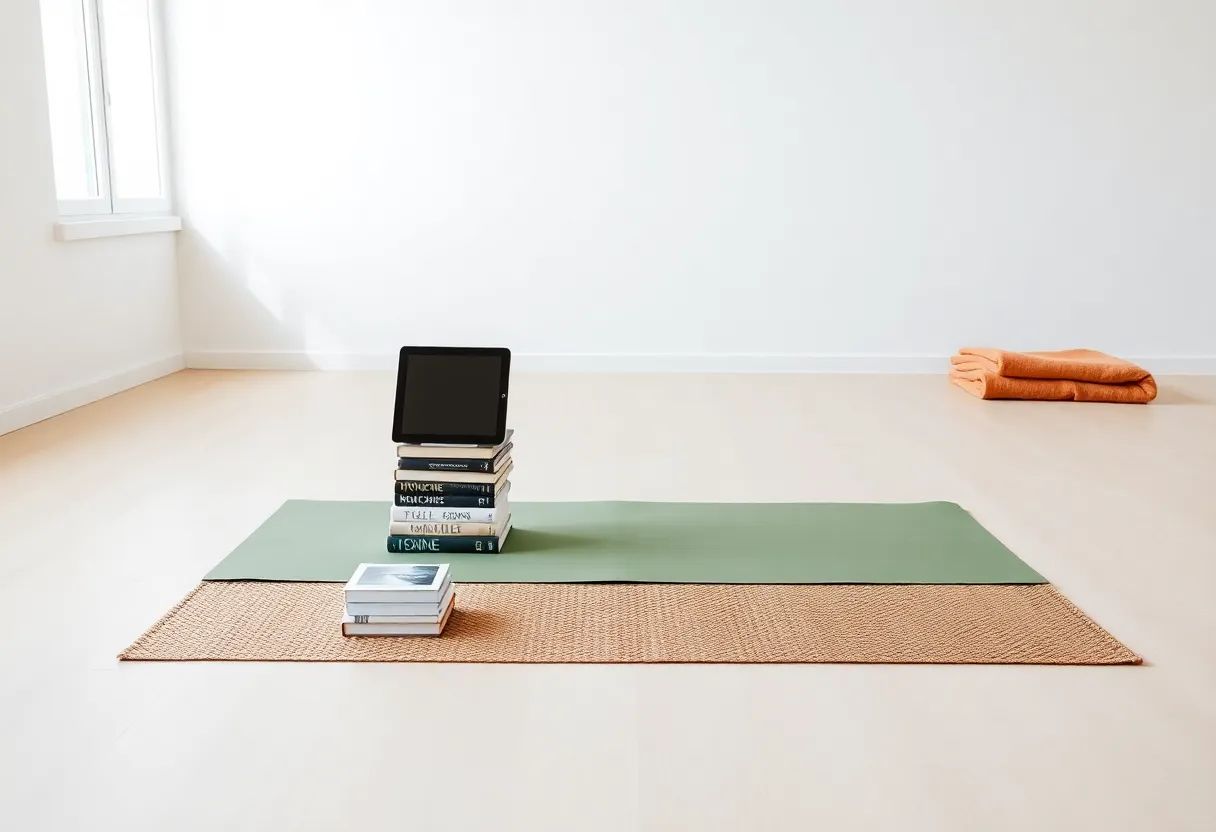
None of this needs a home studio. A therapeutic class asks two ordinary things of a room more than anything else: enough floor to move without hitting furniture, and a camera far enough back to hold the whole body. Decent light and a floor that holds still under bare feet round out the list. Most students already have all four before their first class, in a bedroom or a cleared corner of a shared flat.
How to set up your own room for a class like this walks through the fix for a narrow room or low light, and for carpet or a shared household, in more detail than a page like this needs.
Who actually fits a class like this
The students who end up here are rarely the ones with a free afternoon. Most are desk-bound most of the week, or based outside Singapore altogether, still wanting a bilingual, EN and 中, therapeutic class rather than a generic studio livestream.
Set side by side, a studio class and a live online class trade specific things, not a blanket upgrade in either direction.
| What you're weighing | Studio class | Live online class |
|---|---|---|
| Time per session | Class time plus a commute both ways | Class time only, joined from wherever you are |
| Correction | A teacher's eye, sometimes a hand | The same trained eye, through a full camera frame |
| A missed week | Usually means missing the class outright | Recordings to catch up in your own time |
| Schedule fit | One fixed studio, one fixed slot | The same live slot, joined from home or a work trip |
| First step | Walk in and pay per class or package | SGD 196 for a full first month, unlimited classes |
None of these rows are about discipline or seriousness. They are about which format survives an actual working week. Why online yoga sessions fit even the busiest Singapore schedule makes the rest of that case in full.
The teacher matters more than the format
The question underneath all of this was never really the software. It is whether the person on the other end of the call knows what she is looking at, and says so plainly when a screen genuinely cannot do the rest. Dr. Yun built that habit before she taught her first class. She trained first as a mechanical engineer, learning to find where a structure was quietly failing under load. She has taught yoga for more than a decade since, now as a Yoga Alliance E-RYT 200 instructor, and the engineering training is what she still reaches for on a call to a living room she has never physically stood in.
Her own students often describe this as a standing invitation rather than a technique.
In her classes, no fear of boredom, no fear of getting hurt, no fear of doing it wrong, the only fear is that you won't try. Shannon Yun, Inner Heal student
A screen was never really the obstacle to correcting a bad habit. Not showing up regularly was. The first month at Inner Heal Transformation is built around exactly that: unlimited live online classes for thirty days, at SGD 196, long enough to find out whether a trained eye through a camera catches what a mirror never has.
What decides whether an online yoga class in Singapore is worth a busy professional's time was never the software running it. A teacher who knows what she is looking for, and says so plainly when a screen genuinely cannot finish the job, decides it instead.
Common questions
Does an online yoga class actually work as well as an in-person one?
For most people managing everyday stiffness or a long-standing postural habit, yes. The gap that remains is touch, a hand cueing a movement you cannot yet feel on your own. For a new injury or pain that has not been assessed, start in person first.
How does a teacher correct posture if she cannot touch you?
Through a full-body camera frame and verbal cueing, often demonstrated from a second angle when the first description does not land. It takes a little longer than a single touch would, not a different result.
What device and internet speed do I actually need?
A laptop or phone propped steady is enough. A stable connection matters more than a fast one, so sitting closer to the router solves most issues before class even starts.
Is this suitable for someone who has never done a single yoga class?
Yes. Some of her clearest testimonials come from students who had never practised yoga at all before their first online session.
What if I travel often for work?
A class joined from a hotel room works the same way as one joined from home, provided the camera still shows your whole body. It is part of why the format extends naturally to students based outside Singapore too.
Can I get more individual correction than a group class gives?
Yes. A 1-on-1 session, online or in person in Singapore, is built for exactly that and works well alongside the group classes or on its own.
Is the class taught in English, Mandarin, or both?
Both, as needed within the same class. Instructions and corrections move between English and Mandarin depending on what a student follows most clearly.
What's the easiest way to try this without committing to a long plan?
The first month is unlimited live online classes for SGD 196, with no commitment beyond it. It answers the only question that actually matters, whether the correction holds up for your own body.
When the schedule is the obstacle, format matters more than intention. Start your first month for SGD 196 and fit the classes where they actually go.